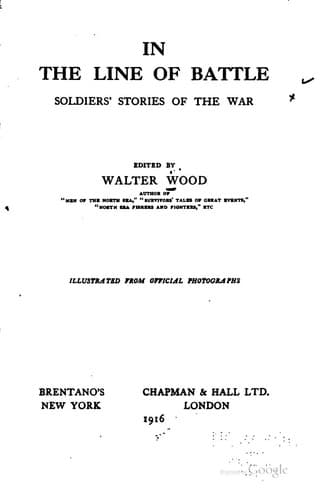
In the Line of Battle: Soldiers' Stories of the War
History
In the Line of Battle: Soldiers' Stories of the War
World War, 1914-1918 -- Personal narratives
When we went out on voyages of discovery we found that the typical
village contained one or two _estaminets_--they are rarely called
cafés in the rural parts of France--and possibly one or two little
shops--_épiceries_--which sell a variety of things appealing to a
soldier’s simple tastes. At certain hours the British Tommy is allowed
in the _estaminets_, where such drinks as beer and red and white wines
and the customary _café au lait_ are obtainable cheaply. It is found
from experience that these places rarely have change for paper money,
which at times is rather awkward, especially when combined with a vague
knowledge of the language; and the usual reply is “No money”--truly
a poor consolation to a thirsty soldier. In time, however, we became
known to the keeper of the _estaminet_, and when money became
circulated the difficulty was remedied. A brief stay in a village was
enough to make the villagers friendly, and little kindnesses on both
sides became a common practice.
A characteristic of every place was the lack of facilities to obtain
extra meals, though at certain _estaminets_ a good repast of fried eggs
and chips, with an occasional dish of stewed rabbit, was procurable.
This is merely a glimpse of the peaceful and gladly welcomed break in
the life of the soldier who is on active service. It makes you all
the more fit for the trenches and that night sentry duty to which you
are so often roused in your dug-out by the corporal shouting, “Next
relief!”
CHAPTER XVII
THE DAILY ROUND
[By way of contrast with the diary which was kept in Gallipoli by an
Australian soldier, and is given on page 180, and as an admirable
companion to that work, there is this diary of a young officer, kept
by him while serving on the Western Front. The diary is of the small,
leather-bound pocket variety, and it was kept by means of the little
pocket-pencil accompanying it, in small, yet clear and coherent
writing, despite shell fire, bombs and other warlike elements. The
extracts are made exactly as they were entered from day to day, and
they form a deeply interesting record of what is “the daily round,
the common task” of a very large number of junior officers who have
undergone precisely the same experiences with unfailing cheerfulness
and courage. The writer after serving in an Officers’ Training Corps,
was posted to a Service battalion of a famous old Line regiment.]
_Dec. 13th, 1915._
Marched to ----, seven miles. Water in places up to the knees. No
billets for B Co. on arrival.
_Dec. 14th._
Marched to ----, three miles.
_Dec. 15th._
Marched up to trenches, ----, eight miles. Awful condition. Big craters
in front, and three saps in our line.
_Dec. 16th._
Narrowest escape of self yet recorded. Shell burst in trench and killed
man one and a half yards away and blew your humble into the mud,
together with another C.O. and others. Two other men wounded. Felt a
bit shaky for some time.
_Dec. 17th._
Public-domain text, read in full here on John Shaqi.
Reviews
Reviews
No reviews yet
Be the first to share your thoughts on this work.
Elsewhere in the archive
Join the Discussion
Join the discussion
Sign in to leave a comment or review.
Sign InorCreate an account