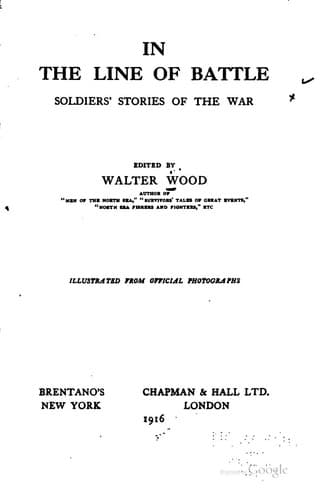
In the Line of Battle: Soldiers' Stories of the War
History
In the Line of Battle: Soldiers' Stories of the War
World War, 1914-1918 -- Personal narratives
This affair, like most of our scraps, was done in the darkness, which
made it all the more thrilling. Well, we dug and sapped and tunnelled
towards the Turks, and when everything had been got ready, powder was
packed in sandbags and fuses were put to them. The deeper the sandbags
the worse the explosion.
All was ready at last. The powder-bags were packed, the fuses were lit,
and then the 11th and 12th Battalions began to finish the work which
the artillery had begun. The guns had started at five o’clock, they
went on booming till nine, then there was a fearful sound which was
louder than the loudest thunder I ever heard, accompanied by an immense
mass of red fire in the blackness of the night. I was two hundred yards
away, but the very earth on which I stood shook and shivered with the
upheaval.
As soon as the crash came our chaps hopped up and rushed the shattered
trenches. They found that a big crater had been made by the explosion,
and that most of the Turks had been stiffened. Those who were left were
either bayoneted or bombed. The Turks did not counter-attack that day.
They had had enough of it. We had a good few casualties, but it was
an effort that was worth while, because it showed that if we wanted
a place we could take it, and at any time we liked. I saw all this
very clearly, for I was going backward and forward all the time as a
stretcher-bearer.
The Turks gave us no chance and we gave them none; but at the same time
they did not do anything that I would call really dirty or out of the
way. A lot of them were fine fellows physically. Some of the Turkish
diggers we got as prisoners had no fighting gear on them at all. They
were just peasants who had been brought up to do the work.
At last I fell ill with dysentery and gastritis, and came home on a
huge hospital ship, with four thousand more sick and wounded soldiers.
We had a six days’ run to Southampton, and had just under sixty deaths
on board. They were buried at sea in batches, the biggest being
eleven--and very solemn it all was.
Now I have done; but I want to tell of just one more little thing that
happened here in England, where I have been in hospital, and where
people have been so good to us.
It was Christmas-time, and we were having a Sunday evening service in
hospital. We were asked what hymns we would like, and a chap spoke out
and said, “Let’s have
‘We plough the fields and scatter
The good seed on the land.’”
The parson was puzzled. He hardly thought we could, because it was
Christmas-time and this was a harvest hymn.
“And it’s harvest-time now at home in Australia,” the chap said.
So we had the good old hymn, and it took us back to home twelve
thousand miles away.
* * * * *
I think the Anzacs did what they set out to do.
CHAPTER VI
“IMPERISHABLE GLORY” FOR THE KENSINGTONS
Public-domain text, read in full here on John Shaqi.
Reviews
Reviews
No reviews yet
Be the first to share your thoughts on this work.
Elsewhere in the archive
Join the Discussion
Join the discussion
Sign in to leave a comment or review.
Sign InorCreate an account