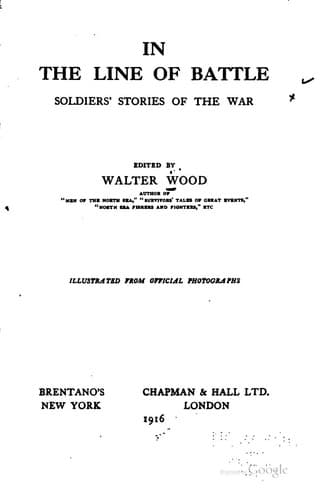
In the Line of Battle: Soldiers' Stories of the War
History
In the Line of Battle: Soldiers' Stories of the War
World War, 1914-1918 -- Personal narratives
[”By your splendid attack and dogged endurance on May 9th, you and your
fallen comrades won imperishable glory for the 13th London Battalion.
It was a feat of arms surpassed by no battalion in this great war.”
This was the fine tribute paid to the 13th (Kensington) Battalion of
the London Regiment by General Sir Henry Rawlinson, commanding the 4th
Army Corps, after the Kensingtons had taken part in the British advance
in May between Bois Grenier and Festubert. The battalion had already
greatly distinguished itself in the Neuve Chapelle operations and
elsewhere. This story of some of the doings of the corps at the front
is told by a member of the Kensingtons, who wishes to remain anonymous.]
The main body of the Kensingtons had gone out in October, and I left
England with a draft in January, the dead of winter. We marched up to
billets in Laventi, three miles from the firing-line. The place was
being heavily shelled by the Germans, and amongst other buildings the
church was smashed up; but the men were lucky, and I don’t think that
any soldiers were hit there. I shall always particularly remember that
place, because it was there that I saw for the first time a man who had
been killed by the enemy.
I was going along a street near an old ruined house which was being
used as a soldiers’ club, when I heard the noise of an exploding shell.
The crash was very near, and soldiers rushed out from the ruined
house to see what had happened. They told me that the shell had burst
farther down the street, and that a civilian had been killed. Without
any loss of time they took a door down, and using this as a stretcher
they carried the dead man away, and as I watched them I realised that
we were fairly in it, and I am bound to say that I was very strangely
moved and deeply impressed by this little tragedy.
[Illustration:
_To face p. 80._
FIELD ARTILLERY NEAR YPRES.]
We realised even more fully what it all meant when for the first time
at the front we put five rounds of ball ammunition in the magazines and
marched off for our first spell in the trenches, between our billets
and the firing-line. We started at dusk, so that we should reach the
trenches just when it became dark.
There was something very solemn in going away like that towards the
enemy; yet there was, of course, intense excitement and curiosity. It
was not a very exhilarating start, because the country was in a very
bad state, owing to the heavy January rains. There was plenty of water
in the trenches when we reached them, and it was bitterly cold. We
were only one night in them that time, but it was a useful breaking-in
experience, and hardened us a bit for the much longer spells, during
which the cold was so intense that the rifles were frozen as they lay
on the parapets, if care had not been taken to keep them well oiled
after firing.
Public-domain text, read in full here on John Shaqi.
Reviews
Reviews
No reviews yet
Be the first to share your thoughts on this work.
Elsewhere in the archive
Join the Discussion
Join the discussion
Sign in to leave a comment or review.
Sign InorCreate an account