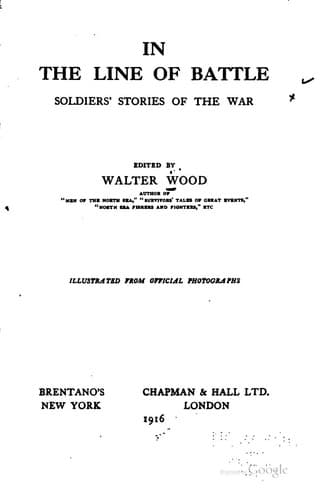
In the Line of Battle: Soldiers' Stories of the War
History
In the Line of Battle: Soldiers' Stories of the War
World War, 1914-1918 -- Personal narratives
At night the Germans threw a searchlight on the “Devil’s Corner,” and
as soon as ever they saw us appear they shelled us, sometimes as many
as four shells coming together; but we dashed on so furiously that
they could not get us, nor did they catch us when we ran the gauntlet
coming back, though they used to get an average of a wagon a night. In
addition to this deadly corner we had three burnt villages to tackle;
but we were always lucky, and our men did not come to grief.
We used to go right up to the trenches, only about twenty-five yards
from them, with the horses and wagons, and there was one specially
dangerous spot which had to be passed. This was where there was a gap
in a hedge, which the Germans knew of quite well and could see. They
knew that at night our troops went to the gap to get water, and so in
the daytime they trained machine-guns on the spot, and when darkness
came they blazed away in the hope of wiping some of our men out. I have
known these guns whirr for five minutes without a break, sending out a
fire so horrible that nothing could live under it. We lost several men
at this gap, and were forced to make an opening in the hedge somewhere
else.
We got into reserve trenches, and here it was that a “whistling
Willy,” which is our nickname for a small German shell, went clean
through a Seaforth and then killed one of our own men in the trenches.
The shell passed through the Highlander intact, and did not explode
until it reached the trenches, a circumstance which shows the amazing
performances of projectiles in this war. You never know what they will
do. At another time one of our chaps, named Steel, was having his hair
cut, when a shell exploded near him and a piece of it, six inches long,
like a needle, struck him through the heart and killed him on the spot.
The winter was a very rough time for us, as we could not keep the water
out of the trenches, and we often had to sleep standing up, during a
four days’ spell in the trenches. Often enough, at the end of one of
these hard spells, we were intensely disappointed because we could not
be relieved, owing to troops being moved elsewhere, and we were forced
to stick it for an extra four days; but we did not forget to make up
for it when we were out, although we had to march a few miles to our
billets to rest, and even then we were not free from shell fire.
By the time I had been at the front seven months I think I had seen
almost every phase of this tremendous war; but I had yet a lot to learn
of what the war means, and I began to learn afresh when we got to Ypres
and later on had a dose of poison-gas.
None of the sights I had seen were to be compared with what we
witnessed in the famous and beautiful old city, which the enemy had
reduced to ruins. They had used shells of every sort, and I saw many
evidences of the havoc and death that had been brought about on
innocent people.
Public-domain text, read in full here on John Shaqi.
Reviews
Reviews
No reviews yet
Be the first to share your thoughts on this work.
Elsewhere in the archive
Join the Discussion
Join the discussion
Sign in to leave a comment or review.
Sign InorCreate an account