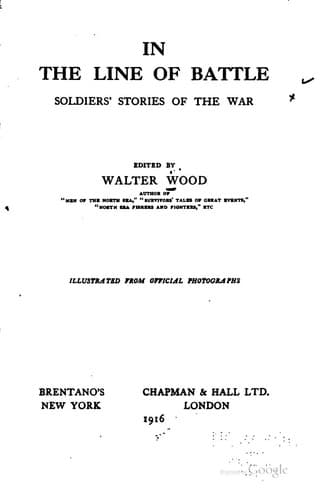
In the Line of Battle: Soldiers' Stories of the War
History
In the Line of Battle: Soldiers' Stories of the War
World War, 1914-1918 -- Personal narratives
I do not know whether I killed any Germans at Liège, but I hope I did.
You could see them falling over, but could not say who killed them.
We hated them because they had come into Belgium.
We were fighting all night, the rifles crackling because of the
constant firing of the magazines.
We chased the Germans into the fields outside Liège. We got at
stragglers with the bayonet, and we brought fifteen prisoners in.
How amusing it was when we caught them! They said, “Oh, my Belgian
brother!” We left them with contempt, and looked after other ones.
Then, when we had got them, they were sent to the station and so to
Antwerp.
The Germans came on in such strength that we could not stop them; but
in spite of all their guns and regiments we held Liège for twenty-four
days. We had only 300,000 Belgians in our army, and the Germans had
about a million; but I would not run away from fifteen Germans myself.
The Belgians called the Germans “swine,” and said, “we will be giving
the Germans one presently!”
And we gave them one.
We went into the trenches, and the Germans were bombarding us and
smashing the place up. We did as much as we could to keep them back.
Houses were smashed and everybody seemed to be killed or wounded. The
shells came on top of you and spread out like an umbrella. A lot of my
friends were killed and fell over in the trenches.
When we were in the trenches a man near me was not happy, because he
was married and his thoughts were with his wife and children and home;
but when we were going on firing I said, “Look! A German has fallen
over again!” And then he was happy. He was married and I was single,
and that made the difference.
If you had your friend in the trenches you did your best for him,
because you liked to take your friend home again; but many friends were
left in the trenches.
Did I see General Leman, the defender and hero of Liège? Oh, yes.
General Leman was a good man. He came round and saw the soldiers and
talked to us and made us happy.
I do not know how many we lost in Liège. We had a lot wounded and
killed and missing; but we only knew this from the newspapers.
We were on duty in the trenches for twenty-four hours, then we were
relieved. At the end of the twenty-four days for which we held Liège
we went to Anden, ten miles away. We retired in the daytime, without
any fighting, and were in Anden about fifteen days. We never saw the
Germans there.
And now I became a motor cyclist, which gave me many adventures and
exciting journeys. I was with a friend, a motor cyclist also, and we
were reconnoitring near Anden. We saw a big house, a château, standing
in its own grounds, with trees. They are beautiful and peaceful houses,
and you saw many of them in Belgium before the war.
“There are some Germans here!” my friend said. We looked and listened,
and what he said was true. There were Germans in the château, but how
many in number we did not know.
Public-domain text, read in full here on John Shaqi.
Reviews
Reviews
No reviews yet
Be the first to share your thoughts on this work.
Elsewhere in the archive
Join the Discussion
Join the discussion
Sign in to leave a comment or review.
Sign InorCreate an account