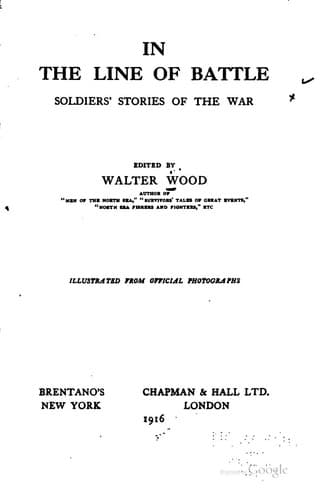
In the Line of Battle: Soldiers' Stories of the War
History
In the Line of Battle: Soldiers' Stories of the War
World War, 1914-1918 -- Personal narratives
[This is a simple, unaffected story of the doings of a young British
soldier in Gallipoli and his subsequent experiences as a prisoner
of war with the Turks. It is told by Private David Melling, 1/8th
Battalion Lancashire Fusiliers. He was a lad when he enlisted, his
eyesight was destroyed by a bullet, he was captured on the battlefield
by the Turks, and was the first British prisoner of war to be released
from Constantinople. The narrator, when seen, was an inmate of the
Blinded Soldiers’ and Sailors’ Hostel, Regent’s Park, N.W., the
wonderful institution which Mr. C. Arthur Pearson founded and controls
with so much success in the interests of those whose affliction he
understands so well.]
I enlisted in the Lancashire Fusiliers in November 1914, when I was
only seventeen years old, and in June 1915 I went to Gallipoli, where
we landed in the night-time. A big ship had been run aground there--the
_River Clyde_--and pontoon bridges had been made at the side of her,
connecting with the shore. We left our transport and got into little
steam trawlers, which were out at the Dardanelles as mine-sweepers
and so on, and these took us to the pontoon bridges. We hurried over
them, under fire, and having got ashore we went straight into a bivouac
rest-camp. We spent five days in the camp, then we went into the
support line of trenches, which is the second line, and after a week or
two we went on fatigue.
We were in a Turkish communication-trench, digging it wider, and we
came across all sorts of queer things. We dug a dead Turk up, a chap
without a head, and near him we dug up one of our short Lee-Enfield
rifles. He had equipment on, and when we looked into his pouches we
found that he had some of our ammunition, besides his own. We supposed
from the look of things that he had been knocked over by a shell and
buried in the rubbish. We were throwing the earth out and making the
trench deeper when we came across the Turk’s head. One chap got it
on a shovel and fired it over the top of the parapet. You got used
to digging bodies up--it was nothing to strike one with your pick or
shovel.
All this experience was good for us, and got us used to fighting before
we were actually in it, because there was firing going on all the
time, and preparations were being made for charging the Turks with the
bayonet.
Things began to get very warm early in August. At about five o’clock
on the afternoon of the 6th, which was a Friday, there was a heavy
bombardment and a big advance on the left of the Peninsula--that
was Suvla Bay. According to the arrangements we were to charge on
the Saturday morning, two hours after the bombardment began. The
bombardment was to have started at five o’clock; but somehow the Turks
got to know about it, and our attack was postponed till ten o’clock. At
that hour we were ready for our job.
Public-domain text, read in full here on John Shaqi.
Reviews
Reviews
No reviews yet
Be the first to share your thoughts on this work.
Elsewhere in the archive
Join the Discussion
Join the discussion
Sign in to leave a comment or review.
Sign InorCreate an account