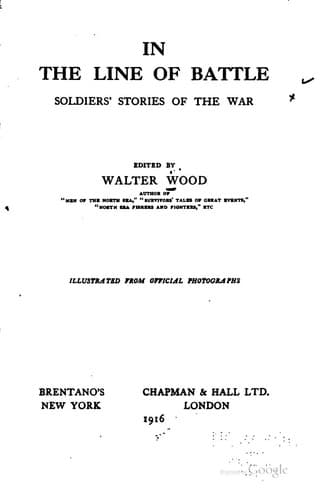
In the Line of Battle: Soldiers' Stories of the War
History
In the Line of Battle: Soldiers' Stories of the War
World War, 1914-1918 -- Personal narratives
I stood up, and then the Turks took me to a communication-trench about
ten yards away.
As I was passing them in the firing-line they hit out at me with their
hands, trying boxing competitions on me. They dared not have done this
if a Turkish officer had been about.
Two more Fusiliers were being led away along with me. They had both
been bayoneted, they told me, after they were captured.
I was taken to a place where there were Turkish doctors. One of them
gave me a cup of tea. He could speak English, and he asked me how I
was. I told him I was pretty bad. I was given a piece of dry bread, but
I could not eat it, because my teeth were closed.
It was here that I met a New Zealander or an Australian, a gunner,
who had been in the charge. He had no right to be in it, but you could
not keep the Anzacs out of the scraps. He said that he and a pal were
passing through the place when they saw what was going on. Each of them
got hold of a rifle and bayonet and rushed into the charge. The pal was
killed and the other man was taken prisoner.
From the doctors’ place I was taken to a sort of dug-out, which had
some kind of grass in it that felt like heather. The two bayoneted
chaps had been taken there as well, and I was very glad to have their
company.
I was left in the dug-out all night, with the other two Fusiliers
alongside of me. In the morning we were put into oxen carts, four
wounded men in each. They were rough things without springs, and were
slowly dragged over rough tracks--you could not call them roads--so
that it was fair torture to us, bumping all the while.
At last we were stopped at a place and changed into another oxen cart,
and taken farther on. We stopped again, and were given a drink out of a
bucket--they must have thought we were horses. I suppose they must have
been giving a mule a drink, and then it struck them that they might
give us a turn. But bucket or no bucket it was a fine drink.
After that I went into a field hospital, and for the first time since I
had been wounded I had my eyes properly attended to.
A Turkish doctor who could speak a little English said “Eyes!” then a
word that sounded like “yolk.” I suppose he meant that my eyes were
gone; but I knew that before he did.
After I had been attended to I was put into a field hospital and fed
three times a day. First of all we had a ration of bread, which had to
last all day, and a drink of tea; about the middle of the day we were
given some soup, which the chaps called “bill-posters’ paste.” It was
awful stuff, and the chaps who were badly wounded in the body could
not do with it, so they used to tipple their lot into my basin and I
would get through it, as well as through my own. I could not eat bread
or anything else, because my jaws were affected and my face was badly
swollen--it is partly swollen still, but I could just manage to suck
the “bill-posters’ paste” through my teeth.
Public-domain text, read in full here on John Shaqi.
Reviews
Reviews
No reviews yet
Be the first to share your thoughts on this work.
Elsewhere in the archive
Join the Discussion
Join the discussion
Sign in to leave a comment or review.
Sign InorCreate an account