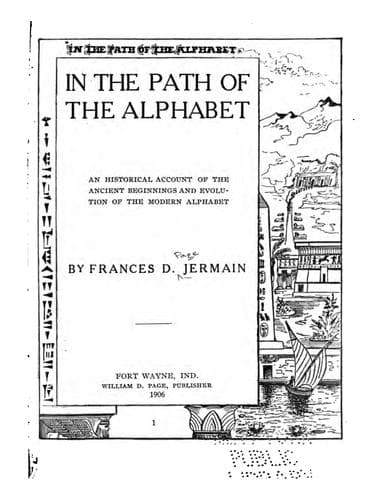
In the path of the alphabet: an historical account of the ancient beginnings and evolution of the modern alphabetJermain, Frances Delavan Page
History
In the path of the alphabet: an historical account of the ancient beginnings and evolution of the modern alphabet
Jermain, Frances Delavan Page
Alphabet
The Assyrian form, Sar Salim, “King of Salem,” is identical with the
Hebrew Sar Shalom, “Prince of Peace.” This again illustrates the
application by Isaiah of the title of “Prince of Peace” to that later
“Prince of the House of David,” who, in a higher spiritual sense than
his great prototype, Melchizedek, was yet to be to all nations and
people “King of Salem” and “Prince of Peace.”
The most remarkable event in the history of archæology has its
connections with the Tel-el-Amarna discovery.
Among the letters in this collection addressed to Amenophis IV, from the
governors of cities in southern Palestine, are those from the governor
of Lachish. This dignitary was named Zimrida and his dispatches to the
king of Egypt were chiefly upon the political conditions of his
province, its dangers from approaching foes and the necessity of relief
from Egypt.
It seems that Zimrida was in greater danger from foes within than
without, for in one of the later letters from Ebed-tob, he alludes to
the murder of Zimrida by servants of the Egyptian king.
The discovery of these cuneiform tablets from southern Palestine had
strengthened the growing convictions of Prof. Sayce that lying beneath
many of the _tels_ or mounds that marked the sites of ancient cities
throughout southern Palestine, other similar treasures were buried. The
name Kirgath Sepher, “Book Town,” was strongly suggestive, and acting
upon these impressions he urged the Palestine Exploration Fund to
undertake explorations in this region.
The Tel-el-Amarna letters were discovered in 1887. It was not, however,
until 1890 that the officers of the Palestine Exploration Fund were able
to obtain the necessary permission from the Turkish government, or to
secure the services of the distinguished explorer, Dr. Petrie, for the
work. This gentleman began excavations in the month of April of that
year.
After some days of examination of various _tels_ in this region for the
site of Lachish, he decided to commence work at the _tel_ or mound
Tel-el-Hesy, so called from the river Hesy which flows by the hill on
which the mound is located. It is about seventeen miles to the east of
Gaza. The natural eminence upon which it is situated rises to a height
of forty feet above the valley. Above this the mound consists of a
succession of town levels, the one above the other, sixty feet higher,
from which a commanding view of the region is obtained.
Public-domain text, read in full here on John Shaqi.
Reviews
Reviews
No reviews yet
Be the first to share your thoughts on this work.
Join the Discussion
Join the discussion
Sign in to leave a comment or review.
Sign InorCreate an account