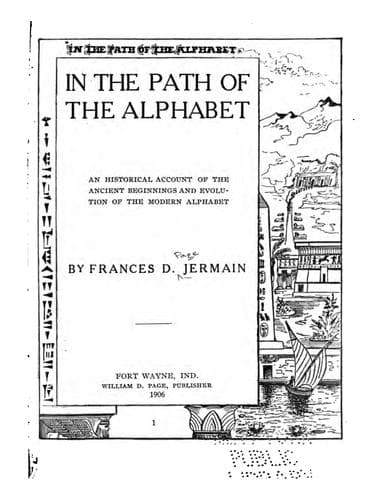
In the path of the alphabet: an historical account of the ancient beginnings and evolution of the modern alphabetJermain, Frances Delavan Page
History
In the path of the alphabet: an historical account of the ancient beginnings and evolution of the modern alphabet
Jermain, Frances Delavan Page
Alphabet
Fortunately for the explorer, the turbulent stream flowing over these
declivities has cut this _tel_ on the eastern side from top to bottom,
leaving the whole face exposed and revealing distinctly the various city
levels of the several periods of occupation. The commanding position of
the site, the fine springs of water, gushing from the hillsides, and the
rapid stream, affording an abundance of fresh, sweet water, the locality
agreeing in so many particulars with the site of ancient Lachish, the
evidences also in the hillside of the existence at various periods of
ancient important cities, justified his convictions which subsequent
discoveries verified.
After some months of excavation, Dr. Petrie was obliged to discontinue
his work here for engagements elsewhere, leaving further explorations in
the hands of Mr. Bliss.
[4]The result of Dr. Petrie’s labors had been to establish known facts
in the history of ancient Lachish. The lowest and earliest town must
have been of great strength and importance. The remains of the walls are
twenty-eight feet and eight inches in thickness, of bricks unburnt, with
two successive patchings of rebuilding occupying thirty-nine of the
sixty feet in the height of the mound. At this level the fragments of
pottery were distinct and peculiar, very different from the relics of
the cities above and which, from relics elsewhere obtained, give the
period of their use and manufacture at 1500 B. C.
The next level indicated a barbaric invasion when rude huts were piled
up, to fall soon after into ruin. After this comes successive strata of
Jewish cities until about 400 B. C., since which time Lachish passed out
of history and no later relics are found.
Of these things Dr. Petrie says: “The Amorite pottery extends from 1500
B. C., to 1000 B. C. Phœnician and Cypriote begins about 1000 and goes
to 700 B. C. Greek influence then begins and continues to the top of the
town.”
Upon leaving, he pointed out to Dr. Bliss the indications that the lower
portions of the _tel_ would bring to light the ruins of a city destroyed
by the invading Israelites.
Among the early relics found by Mr. Bliss, when the lower stratum of
cities was more thoroughly explored, were a number of Egyptian beads and
scarabs of the eighteenth Egyptian dynasty, on one of which the name of
Queen Teie, wife of Amenophis III and mother of Amenophis IV, appears.
There were also a number of seal cylinders, some of Egyptian and some of
Babylonian manufacture, of the same period or earlier.
The most wonderful discovery, however, was to come, verifying the
predictions of Prof. Sayce and the judgment of Dr. Petrie, but in a way
to astonish even these eminent scholars to whom all things seem
possible. This was the discovery of a clay tablet inscribed in cuneiform
characters similar in size, form and other peculiarities, to the letters
from Lachish in the Tel-el-Amarna documents.
Public-domain text, read in full here on John Shaqi.
Reviews
Reviews
No reviews yet
Be the first to share your thoughts on this work.
Join the Discussion
Join the discussion
Sign in to leave a comment or review.
Sign InorCreate an account