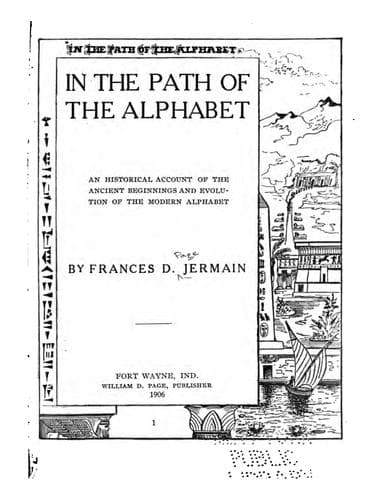
In the path of the alphabet: an historical account of the ancient beginnings and evolution of the modern alphabetJermain, Frances Delavan Page
History
In the path of the alphabet: an historical account of the ancient beginnings and evolution of the modern alphabet
Jermain, Frances Delavan Page
Alphabet
Under the later Sassanian kings, the Avesta was transcribed in the later
Pehlevi or Parsee script, in which form it has survived to the present
day. Of this, however, but a portion remains. The Sassanian dynasty
ended with the conquest of Persia by the Mohammedan Arabs in 641 A. D.
In the fury of persecution which broke over all Iran at this time,
Zoroastrianism as a national faith was crushed, and the sacred
literature of Persia was again scattered abroad by the devastating
influences of war and fanaticism. To the religion of Zoroaster that of
Mohammed succeeded, the Avesta was replaced by the Koran, and the
Arabian alphabet supplanted the Persian as a national script and has so
remained to the present.
The ancient national life of Persia was not crushed out at once, but
continued a vigorous though ineffectual resistance for centuries.
During these troublous times, probably about the ninth century A. D., a
colony of Persians who held fast to their ancient faith, fled from their
country, and after many years wanderings, finally established themselves
on the western coast of India, from Bombay to Surat. They brought with
them the remains of their sacred literature, to which other missing
portions were added from time to time, as they could obtain them from
their brethren in the faith who remained in Persia, chiefly at Kerman
and Yezd.
They adopted the language of the Hindus among whom they settled, but
steadfastly maintained their religion and customs.
It is from the descendants of these refugees—the Parsees of India—that
the ancient sacred books of Persia have come into our hands.
The Avesta as it now exists, consists of four[6] parts, the Yasna, the
Visparad, the Vendidad and the Kordash, or Little Avesta. Each of these
parts are remainders of the older collection and are of different dates.
The Yasna, a collection of hymns and prayers for divine service,
includes the “Gathas,” the most ancient and sacred portion of the
Avesta. These are evidently what they claimed to be—the work of
Zoroaster. The language in which they are composed is as old, if not
more ancient than the Sanskrit of the oldest Vedas.
The allusion to these hymns throughout the various parts of the Avesta,
shows them to have been in existence long before all other portions of
these collections were written.
Again, to all to whom Zoroaster is a living personality, the internal
evidences of these utterances point distinctly to him as their author.
Claiming no higher distinction than a teacher and preacher among his
people, there could have been no time in the history of the religion of
which he was the founder, than during his own life and work in which
they could have had their origin.
These devout pleadings with the Divine for his people, that he and they
might be led aright, does not savour of the higher spiritual dignities
accorded to Zoroaster in later times.
Public-domain text, read in full here on John Shaqi.
Reviews
Reviews
No reviews yet
Be the first to share your thoughts on this work.
Elsewhere in the archive
Join the Discussion
Join the discussion
Sign in to leave a comment or review.
Sign InorCreate an account