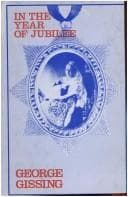
English fiction -- 19th century; Victoria, Queen of Great Britain, 1819-1901 -- Fiction
She wrote to Mr. Barmby, senior, informing him of her return, in
improved health, to Grove Lane, and thanking him once more for his
allowing her to make so long a stay in Cornwall. If he wished to see
her, she would be at home at any time convenient to him. In a few days
the old gentleman called, and for an hour or two discoursed well-meaning
commonplace. He was sorry to observe that she looked a trifle pale; in
the autumn she must go away again, and to a more bracing locality--he
would suggest Broadstairs, which had always exercised the most
beneficial effect upon his own health. Above all, he begged her to
refrain from excessive study, most deleterious to a female constitution.
Then he asked questions about Horace, and agreed with Nancy that the
young man ought to decide upon some new pursuit, if he had definitely
abandoned the old; lack of steady occupation was most deleterious at his
age. In short, Mr. Barmby rather apologised for his guardianship than
sought to make assertion of it; and Nancy, by a few feminine devices,
won a better opinion than she had hitherto enjoyed. On the day
following, Samuel Barmby and his sisters waited upon Miss. Lord; all
three were surprisingly solemn, and Samuel talked for the most part of a
‘paragraph’ he had recently read, which stated that the smoke of London,
if properly utilised, would be worth a vast sum of money. ‘The English
are a wasteful people,’ was his conclusion; to which Nancy assented with
a face as grave as his own.
Not a little to her astonishment, the next day brought her a long letter
in Samuel’s fair commercial hand. It began by assuring her that the
writer had no intention whatever of troubling her with the renewal of
a suit so firmly rejected on more than one occasion; he wished only to
take this opportunity of her return from a long absence to express the
abiding nature of his devotion, which years hence would be unbroken
as to-day. He would never distress her by unwelcome demonstrations;
possibly she might never again hear from his lips what he now committed
to paper. Enough for him, Samuel, to cherish a love which could not but
exalt and purify him, which was indeed, ‘in the words of Shakespeare, “a
liberal education.”’ In recompense of his self-command, he only besought
that Miss. Lord would allow him, from time to time, to look upon her
face, and to converse with her of intellectual subjects. ‘A paper,’
he added, ‘which I read last week at our Society, is now being
printed--solely at the request of friends. The subject is one that may
interest you, “The Influence of Culture on Morality.” I beg that you
will accept the copy I shall have the pleasure of sending you, and that,
at some future date, you will honour me with your remarks thereon.’
Public-domain text, read in full here on John Shaqi.
Reviews
Reviews
No reviews yet
Be the first to share your thoughts on this work.
Elsewhere in the archive
Join the Discussion
Join the discussion
Sign in to leave a comment or review.
Sign InorCreate an account