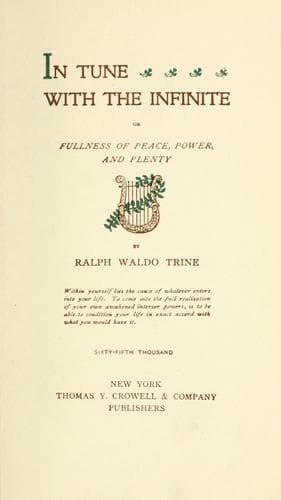
In Tune with the Infinite; or, Fullness of Peace, Power, and PlentyTrine, Ralph Waldo
Religion
In Tune with the Infinite; or, Fullness of Peace, Power, and Plenty
Trine, Ralph Waldo
New Thought
The view of God in regard to which we are agreed, that He is the
Infinite Spirit of Life and Power that is back of all, that is working
in and through all, that is the life of all, is a matter in regard to
which all men, all religions can agree. With this view there can be no
infidels or atheists. There are atheists and infidels in connection
with many views that are held concerning God, and thank God there are.
Even devout and earnest people among us attribute things to God that no
respectable men or women would permit to be attributed to themselves.
This view is satisfying to those who cannot see how God can be angry
with his children, jealous, vindictive. A display of these qualities
always lessens our respect for men and women, and still we attribute
them to God.
The earnest, sincere heretic is one of the greatest friends true
religion can have. Heretics are among God's greatest servants. They
are among the true servants of mankind. Christ was one of the greatest
heretics the world has ever known. He allowed himself to be bound by
no established or orthodox teachings or beliefs. Christ is
preeminently a type of the universal. John the Baptist is a type of
the personal. John dressed in a particular way, ate a particular kind
of food, belonged to a particular order, lived and taught in a
particular locality, and he himself recognized the fact that he must
decrease while Christ must increase. Christ, on the other hand, gave
himself absolutely no limitations. He allowed himself to be bound by
nothing. He was absolutely universal and as a consequence taught not
for his own particular day, but for all time.
This mighty truth which we have agreed upon as the great central fact
of human life is the golden thread that runs through all religions.
When we make it the paramount fact in our lives we will find that minor
differences, narrow prejudices, and all these laughable absurdities
will so fall away by virtue of their very insignificance, that a Jew
can worship equally as well in a Catholic cathedral, a Catholic in a
Jewish synagogue, a Buddhist in a Christian church, a Christian in a
Buddhist temple. Or all can worship equally well about their own
hearth-stones, or out on the hillside, or while pursuing the avocations
of every-day life. For true worship, only God and the human soul are
necessary. It does not depend upon times, or seasons, or occasions.
Anywhere and at any time God and man in the bush may meet.
Public-domain text, read in full here on John Shaqi.
Reviews
Reviews
No reviews yet
Be the first to share your thoughts on this work.
Elsewhere in the archive
Join the Discussion
Join the discussion
Sign in to leave a comment or review.
Sign InorCreate an account