Few Indians possess any number of books, either in their own language
or in English. The lesson books they may have used at school or
college gradually get dispersed. Even in the houses of educated people
little provision in the shape of bookcases is to be found. A recess in
the wall may contain a shelf or two on which a few books are placed in
disorderly array, but they are seldom read. Even those who read books
take little pleasure in their outward appearance, and the binding is
to them nothing more than a necessary protection to the book inside
it. Some wealthy Indian, following to some extent Western fashions in
his house, may have in his reception-room the _Encyclopaedia
Britannica_, and a library edition of Dickens, elaborately bound. But
they are rarely opened and only form part of the decorative furniture
of the room, and stand a poor chance of notice in competition with the
big gramophone which, nowadays, is to be found in many well-to-do
Eastern households.
Indians have yet to learn to treat books with the respect which is
instinctive amongst people of refinement in most European countries.
To see a book rudely treated, or knocked about, is almost as
distressing to many people as if it was an object sensitive to pain.
But a book in the hands of even a cultivated Indian is almost sure to
suffer. If it is a new book, he will open it vigorously, and bend it
back as far as it will go, in order to make it open properly. Its
broken back is the permanent memento of the treatment it has
received. Even Christian Indians are slow to learn the outward respect
due to their religious books. Their prayer books and hymn books, more
often than not, soon go to pieces for want of reasonable care,
although women are much more careful than men. Want of appreciation of
the value of a book may partly arise from the fact that nearly all the
books which Christians use have been sold to them under cost price,
through the help of societies. Bible societies issue copies of the
Scriptures at extraordinarily cheap rates, so that they may come
within the reach of everybody, however poor. Vernacular prayer books
are generally sold at a cost much below that of their production. This
was inevitable in early days when Christians were few in number, and
often poor. But it has left the impression that a book is a thing of
little value, easily replaced.
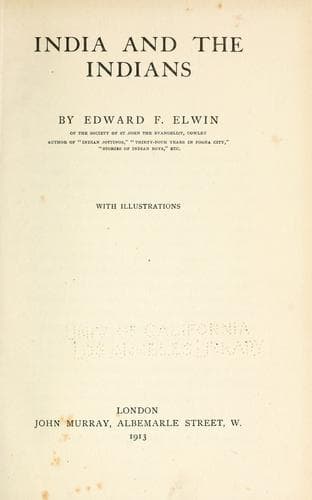
A Brahmin seeing a book on India on my table which he thought he would
like to have, asked the price. On hearing that it was seven or eight
shillings, he lifted up his hands in dismay and said, "The price is
prohibitive. Write and tell Messrs Murray & Co."
Public-domain text, read in full here on John Shaqi.
Reviews
Reviews
No reviews yet
Be the first to share your thoughts on this work.
Elsewhere in the archive
Join the Discussion
Join the discussion
Sign in to leave a comment or review.
Sign InorCreate an account