The great bulk of the population, mostly a simple and ignorant peasantry
whose horizon does not extend beyond their own village and the fields
that surround it, accepted with more or less conscious gratitude the
material benefits conferred upon them by alien rulers with whom they
were seldom brought into actual contact save through the occasional
presence of a District officer on tour, almost invariably humane and
kindly and anxious to do even-handed justice to all. Another class of
Indians, chiefly dwellers in large cities, infinitesimally small
numerically but constantly increasing in numbers and still more rapidly
in activity and influence, saw, however, in an autocratic form of
government, of which it even questioned the efficiency, an
insurmountable barrier to the aspirations which Western education had
taught it to entertain. The list of graduates from Indian Universities
lengthened every year, the number of schools and colleges in which young
Indians acquired at least the rudiments of Western knowledge grew and
multiplied in every province. Western-educated Indians flocked to the
bar; they showed themselves qualified for most of the liberal
professions; they filled every post that was open to them in the public
services. But where, they asked with growing impatience, was the
fulfilment of the hopes which they had founded on the Queen's
Proclamation of 1858? There had been perhaps no departure from the
letter of the Proclamation, but had its spirit been translated into
effective practice? Was it never to be interpreted in the same generous
sense in which a still earlier generation of British administrators had
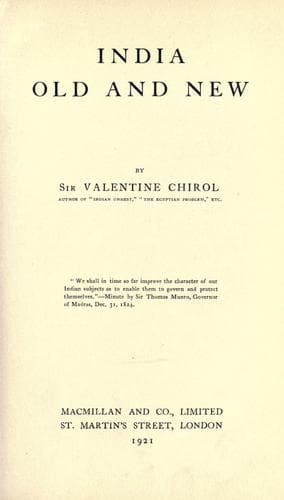
interpreted their mission as a means to train the Indians to protect and
govern themselves?
Public-domain text, read in full here on John Shaqi.
Reviews
Reviews
No reviews yet
Be the first to share your thoughts on this work.
Elsewhere in the archive
Join the Discussion
Join the discussion
Sign in to leave a comment or review.
Sign InorCreate an account