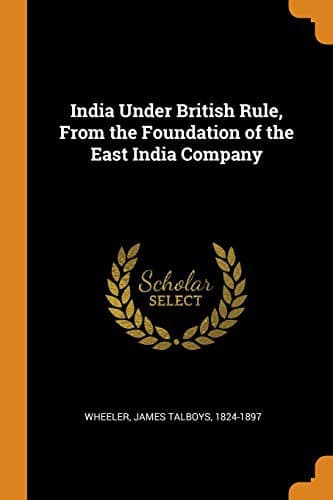
India Under British Rule from the Foundation of the East India CompanyWheeler, James Talboys
History
India Under British Rule from the Foundation of the East India Company
Wheeler, James Talboys
India -- History -- British occupation, 1765-1947
§15. In 1856 Lord Dalhousie left India for ever. He had alarmed
Anglo-Indians of the old school by his energetic promotion of moral and
material progress without regard to the ignorance or prejudices of the
Asiatic populations; but besides his grander measures, he carried out a
thousand and one smaller reforms which to this day are felt and
appreciated by Asiatics as well as by Europeans. It was Lord Dalhousie
who introduced cheap postage; who caused Calcutta to be lit with gas;
who purified the south-west breezes of fever and malaria by clearing the
jungles of the Sunderbunds; who sat by the cradle of the new legislative
council of 1854, and thus nourished the earliest germ of representative
government which British rule had planted in India. In a word, Lord
Dalhousie prepared the way for that great measure which will be told in
a future chapter, namely, the transfer of the government of India from
the East India Company to the British Crown.
[Sidenote: Lord Canning 1856-62. War with Persia, 1856-7.]
§16. Lord Canning succeeded Lord Dalhousie in 1856. To all outward
appearance there was no cause for alarm in any part of India. Persia had
again laid siege to Herat, as she had done in 1837; but the British
government had come to an understanding with old Dost Mohammed of Cabul,
and had given him money and arms. A mission was sent to Candahar under
Major (now Sir Peter) Lumsden. A British expedition was sent to the
Persian Gulf under Sir James Outram, and captured Bushire. Eventually
Persia withdrew her pretensions as regards Herat, and peace was
concluded in March, 1857.
[Sidenote: Status of the "king" at Delhi.]
[Sidenote: Proposed removal from Delhi.]
Meanwhile the status of the so-called king of Delhi, the relic of the
Great Mogul, was under consideration. For more than half a century the
family had lived in a palace at Delhi on a yearly pension from the
British government. There was much marrying and giving in marriage, and
the palace was a hive of princes and princesses without any apparent
occupation save that of petitioning for increased pensions. Lord
Ellenborough contemplated removing the family from Delhi, but the
measure was postponed. At last Lord Dalhousie took action. The so-called
king was very old, and could not live many years. Lord Dalhousie
recognised a grandson as successor to the pageant throne, on the
condition that when the old king died, the whole family should clear out
of Delhi and take up their abode in a royal residence some miles off,
known as the Kutub.
[Sidenote: Palace intrigues.]
Public-domain text, read in full here on John Shaqi.
Reviews
Reviews
No reviews yet
Be the first to share your thoughts on this work.
Elsewhere in the archive
Join the Discussion
Join the discussion
Sign in to leave a comment or review.
Sign InorCreate an account