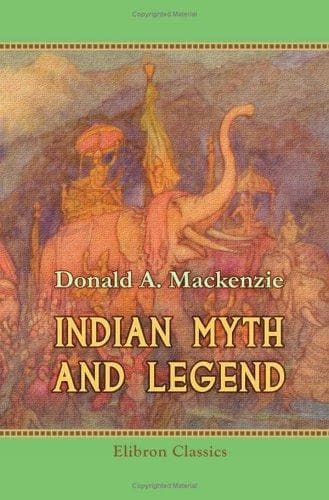
Indian Myth and LegendMackenzie, Donald A. (Donald Alexander)
History
Indian Myth and Legend
Mackenzie, Donald A. (Donald Alexander)
Hindu mythology; Legends -- India
There was, however, more than one “school of thought” among the
Brahmans. The sages who memorized and repeated the older Upanishads,
and composed new ones, could not have failed to pass unrecorded
judgments on the superstitious practices of their ritualistic
brethren. Account must also be taken of the example and teachings of
the bands of wandering devotees, the Bhiksus, who neither performed
penances nor offered up sacrifices, and of the influence exercised
by the independent thinkers among the Kshatriyas, who regarded with
disfavour the pretensions of the powerful priesthood. The elements
of revolt could never have been absent during the two centuries of
the Brahmanical Age. Upanishadic teachings had stirred the minds of
thinking men, but they had one marked defect; they left unsatisfied
the religious sense which could find no repose in a jungle of abstract
thought. It was impossible, however, for the leaders of thought to
return to the polytheism of the Vedic Age, or to worship deities
controlled by human beings. A new and higher religion became a
necessity for those who, like the Hebrew Psalmist, appear to have cried:
“O Lord ... thou desirest not sacrifice, else would I give it; thou
delightest not in burnt offering. The sacrifices of God are a broken
spirit.”
—_Psalms_, li, 16, 17.
At any rate, we find that, before the Brahmanical Age had ended,
the conception was becoming more prevalent of a supreme personal
god, greater than Indra or Agni, and worthy of minds influenced by
the _Upanishads_—a god who was the embodiment of the First Cause,
an Infinite Being uncontrolled by the priesthood. One section of the
people appears to have worshipped Vishnu as the Celestial incarnation
of the World Soul, while another gave recognition to Shiva. In the
absence of records, however, it is impossible to ascertain to what
extent monotheistic ideas were developed by unorthodox teachers. The
new doctrines may have degenerated, like Buddhism, as they became
widespread. It is evident, however, that the priesthood were unable to
ignore them, for they are referred to in their “books”.
Public-domain text, read in full here on John Shaqi.
Reviews
Reviews
No reviews yet
Be the first to share your thoughts on this work.
Elsewhere in the archive
Join the Discussion
Join the discussion
Sign in to leave a comment or review.
Sign InorCreate an account