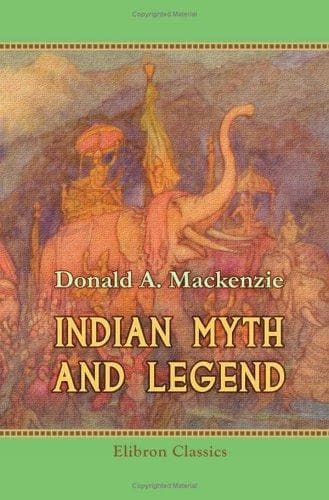
Indian Myth and LegendMackenzie, Donald A. (Donald Alexander)
History
Indian Myth and Legend
Mackenzie, Donald A. (Donald Alexander)
Hindu mythology; Legends -- India
King Kansa had resort to many stratagems to accomplish the death
of Krishna, but his own doom could not be set aside; ultimately he
was slain by the two brothers. The _Harivamsa_, an appendix to the
_Mahábhárata_, which is as long as the Iliad and the Odyssey together,
is devoted to the life and adventures of Krishna, who also figures in
the _Puranas_.
Vishnu's Buddha Avatara was assumed, according to orthodox teaching,
to bring about the destruction of demons and wicked men who refused to
acknowledge the inspiration of the Vedas and the existence of deities,
and were opposed to the caste system. This attitude was assumed by the
Brahmans because Buddhism was a serious lay revolt against Brahmanical
doctrines and ceremonial practices.
Buddha, “the Enlightened”, was Prince Siddartha of the royal family
Gautama, which, as elsewhere told, ruled over a Sakya tribe. At his
birth marvellous signs foretold his greatness. Reared in luxury, he was
kept apart from the common people; but when the time of his awakening
came, he was greatly saddened to behold human beings suffering from
disease, sorrow, and old age. One night he left his wife and child, and
went away to live the life of a contemplative hermit in the forest,
with purpose to find a solution for the great problem of human sin and
suffering. He came under the influence of Upanishadic doctrines, and
at the end of six years he returned and began his mission.
Buddha, the great psychologist, was one of the world's influential
teachers, because his doctrines have been embraced in varying degrees
of purity by about a third of the human race. Yet they are cold and
unsatisfying and gloomy. The “Enlightener's” outlook on life was
intensely timid and pessimistic; he was an “enemy of society” in
the sense that he made no attempt to effect social reforms so as to
minimize human suffering, which touched him with deepest sympathy, but
unfortunately filled him with despair; his solution for all problems
was Death; he was the apostle of benevolent Nihilism and Idealistic
Atheism.
There is no supreme personal god in Buddhism and no hope of
immortality. Gods and demons and human beings are “living creatures”;
gods have no power over the Universe, and need not be worshipped or
sacrificed to, because they are governed by laws, and men have nothing
to fear from them.
Public-domain text, read in full here on John Shaqi.
Reviews
Reviews
No reviews yet
Be the first to share your thoughts on this work.
Elsewhere in the archive
Join the Discussion
Join the discussion
Sign in to leave a comment or review.
Sign InorCreate an account