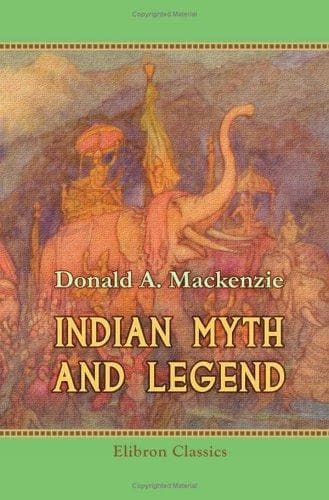
Indian Myth and LegendMackenzie, Donald A. (Donald Alexander)
History
Indian Myth and Legend
Mackenzie, Donald A. (Donald Alexander)
Hindu mythology; Legends -- India
Duryodhana was well pleased at this proposal, and he went before his
blind father, the maharajah, and prevailed upon him to invite the
Pandavas to Hastinapur for a friendly gambling match, despite the
warnings of the royal counsellors.
Said Dhritarashtra: “If the gods are merciful, my sons will cause no
dispute. Let it be as fate hath ordained. No evil can happen so long
as I am near, and Bhishma and Drona are near also. Therefore, let the
Pandavas be invited hither as my son desireth.”
So Vidura, who feared trouble, was sent unto Indra-prastha to say:
“The maharajah is about to hold a great festival at Hastinapur, and he
desires that Yudhishthira and his brethren, their mother Pritha and
their joint wife Draupadi, should be present. A great gambling match
will be played.”
When Yudhishthira heard these words, he sorrowed greatly, for well
he knew that dice-throwing was ofttimes the cause of bitter strife.
Besides, he was unwilling to play Prince Shakuni, that desperate
and terrible gambler.... But he could not refuse the invitation of
Dhritarashtra, or, like a true Kshatriya, disdain a challenge either to
fight or to play with his peers.
So it came to pass that the Pandava brethren, with Pritha, their
mother, and their joint wife Draupadi, journeyed to Hastinapur in
all their splendour. Dhritarashtra welcomed them in the presence of
Bhishma and Drona and Duryodhana and Karna; then they were received
by Queen Gandhari, and the wives of the Kaurava princes; and all the
daughters-in-law of the blind maharajah became sad because that they
were jealous of the beauty of Draupadi and the splendour of her attire.
The Pandava lords and ladies went unto the dwelling which had been
prepared for them, and there they were visited in turn by the lords and
ladies of Hastinapur.
On the day that followed, Yudhishthira and his brethren went together
to the gambling match, which was held in a gorgeous pavilion, roofed
with arching crystal and decorated with gold and lapis lazuli: it had a
hundred doors and a thousand great columns, and it was richly carpeted.
All the princes and great chieftains and warriors of the kingdom were
gathered there. And Prince Shakuni of Gandhari was there also with his
false dice.
When salutations had passed, and the great company were seated, Shakuni
invited Yudhishthira to play.
Said Yudhishthira: “I will play if mine opponent will promise to throw
fairly, without trickery and deceit. Deceitful gambling is sinful,
and unworthy a Kshatriya; there is no prowess in it. Wise men do not
applaud a player who winneth by foul means.”
Shakuni said: “A skilled gambler ever playeth with purpose to vanquish
his opponent, as one warrior fighteth another less skilled than himself
to accomplish his overthrow. Such is the practise in all contests; a
man plays or fights to achieve victory.... But if thou art in dread of
me, O Yudhishthira, and afraid that thou wilt lose, 'twere better if
thou didst not play at all.”
Public-domain text, read in full here on John Shaqi.
Reviews
Reviews
No reviews yet
Be the first to share your thoughts on this work.
Elsewhere in the archive
Join the Discussion
Join the discussion
Sign in to leave a comment or review.
Sign InorCreate an account