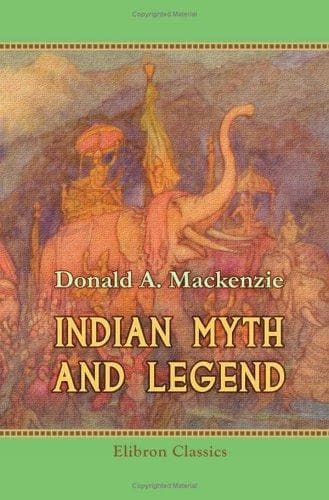
Indian Myth and LegendMackenzie, Donald A. (Donald Alexander)
History
Indian Myth and Legend
Mackenzie, Donald A. (Donald Alexander)
Hindu mythology; Legends -- India
Rama performed sacrifices to propitiate the God of Ocean, so that
the Vanar forces might be enabled to pass over to Lanka, but these
proved to be unavailing. Then angrily he seized his bow and shot
Celestial weapons into the bosom of the deep. The earth and the sea
were immediately convulsed, and darkness covered the heavens; lightning
flashed and thunder bellowed aloud; the mountains began to break in
pieces. Rama next seized a fiery dart and threatened to dry up the
waters of the sea.
At that moment the King of Ocean rose serenely above the weltering
billows in all his splendour, attended by shining water snakes. He
addressed Rama with great reverence, reminding him that according to
ancient laws he must remain unfordable, but counselling him the while
to seek the aid of the Vanar chief Nala, son of Vishwakarma, the divine
artisan, so that a bridge might be constructed to enable the armies to
cross the deep. Then the King of Ocean vanished amidst the waves and
the heavens brightened again.
Nala was immediately called upon to give his aid. Assisted by his
workmen, this wonderful Vanar, whose body was green, constructed a
causeway of rocky islands between the mainland and Lanka (Ceylon), and
to this day it is called “Rama's Bridge”.[345]
[345] Also “Adam's Bridge”. The green Celtic fairies are similarly
credited with making island chains and long jutting promontories which
stretch out from opposite shores of arms of the sea.
Rama meanwhile set up the Linga symbol of the god Shiva, and worshipped
it on that holy island which hath since been called Ramisseram.
In five days the strait was spanned. Then Rama mounted on the back of
Hanuman, son of the wind god Vayu, and Lakshmana mounted the back of
Angada, son of Bali and grandson of Indra, and led the Vanar hosts
across the sea. The apes and bears which composed the great attacking
army leapt from island to island, shouting: “Victory to Rama!” “Victory
to Lakshmana!” “Victory to Sugriva!” Now the apes were of many colours;
they were white and black, green and blue, yellow and red and brown.
Sugriva shone like silver, Angada resembled a white lotus; Nila, son of
Agni, was red, and Hanuman was yellow as pure gold; Sarambha had also
a yellow body, and Nala was green, while Darvindha had a black body, a
red face, and a yellow tail. These were all leaders and great warriors
of the Vanar host.
The army landed in Lanka unopposed, and encamped on a plain fronting
the capital of the Rakshasa king.
The Rakshasas issued forth speedily to attack the apes, and the blowing
of horns and beating of drums sounded like to the mighty thunder peals
at a Yuga end. Indrajit was the Rakshasa leader. His followers rode
on elephants and lions, on camels and asses, on hogs and hyenas,
and on wolves; they were armed with bows and arrows, maces, spears,
tridents, swords, and beams, but some had also magic weapons. Roaring
and swaying, they drove forward like to long sea-rollers assaulting the
shore.
Public-domain text, read in full here on John Shaqi.
Reviews
Reviews
No reviews yet
Be the first to share your thoughts on this work.
Elsewhere in the archive
Join the Discussion
Join the discussion
Sign in to leave a comment or review.
Sign InorCreate an account