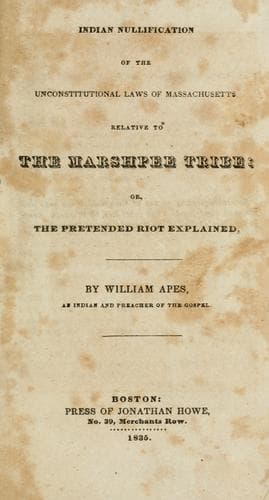
Indian Nullification of the Unconstitutional Laws of Massachusetts Relative to the Marshpee Tribe: Or, the Pretended Riot ExplainedApess, William
History
Indian Nullification of the Unconstitutional Laws of Massachusetts Relative to the Marshpee Tribe: Or, the Pretended Riot Explained
Apess, William
Indians of North America -- Legal status, laws, etc.; Mashpee Indians -- Land tenure; Mashpee Indians -- Legal status, laws, etc.
In possession of: Gideon Hawley
: Simon Fish.
Received November 10, 1800, and is recorded in the 25th Book
of Records, for the County of Barnstable, folio 139, and
compared.
Attest, EBENEZER BACON, _Register_.
Lot Nye was a white man, a great Indian speculator. The other five
were Indians, two calling themselves Selectmen. Now what power had
these men in 1783, to sequester four hundred acres of the common land
of the Indians, for any purpose? If they were Selectmen, and had any
power, that power was expressly limited by the act of 1763, to leasing
lands for a term not exceeding two years. Here they undertook to make
a perpetual grant, a sort of dedication of the property to a certain
purpose. If they could dispose of one acre so, they might with equal
propriety, have disposed of the whole Plantation. The Indians were all
tenants in common, and no dedication or transfer of the common land
could be made, without a legal partition, or the consent of every
individual tenant. If the pretended Selectmen acted for the Indians,
they could only do so by power of attorney to act for all the tenants
in common. There is no other possible legal way, by which land, the
fee of which is owned by tenants in common, can be transferred, either
in fee or in occupancy out of their possession forever. But besides,
no act of the Indians was then valid unless confirmed by the General
Court. This deed, therefore, of 1783, was void at the time. It seems
nothing was done with it, until 1800, _seventeen years_ after, when
it was recorded in the Barnstable County Registry of Deeds, at whose
instigation does not appear. Now in 1800, when this deed was recorded,
the Indians were legally minors, and could do no act, and make no
contract. All the power their Selectmen had in 1783, was taken away.
They were under five Overseers, who had power to improve and _lease_
the lands of the Indians and their tenements, but no power to sell,
sequester or dedicate any part of them. The Overseers had no power to
take a dollar from the Indians, for religious worship. While this was
the condition of the Indians under the law of 1789, (which continued
in full force, with an additional act in 1819, till the new law of
1834,) the deed was recorded, in 1800, _seventeen years_ after it
was made by persons who had no power at all to make such a deed. The
professed object was to set apart 400 acres, of the common land,
lying in Marshpee, "_and being Indian_ _property_," for a parsonage,
forever. The clear title then was in the Indians as tenants in common,
for the deed so declares it, in 1783. The parsonage was their property
then. How has it ever been conveyed out of their hands? The purpose
for which this land was to be used, as sequestered by Lot Nye, &c. was
for the sole purpose aforesaid, viz. "For the support of the Gospel
in Marshpee in all future generations, according to the discipline
Public-domain text, read in full here on John Shaqi.
Reviews
Reviews
No reviews yet
Be the first to share your thoughts on this work.
Elsewhere in the archive
Join the Discussion
Join the discussion
Sign in to leave a comment or review.
Sign InorCreate an account