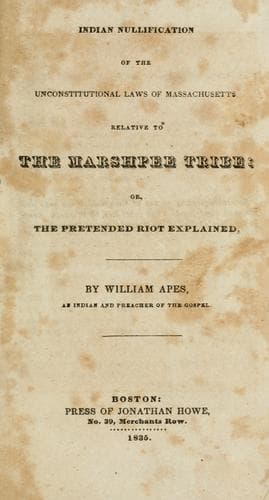
Indian Nullification of the Unconstitutional Laws of Massachusetts Relative to the Marshpee Tribe: Or, the Pretended Riot ExplainedApess, William
History
Indian Nullification of the Unconstitutional Laws of Massachusetts Relative to the Marshpee Tribe: Or, the Pretended Riot Explained
Apess, William
Indians of North America -- Legal status, laws, etc.; Mashpee Indians -- Land tenure; Mashpee Indians -- Legal status, laws, etc.
Now, if the deed was not valid in 1783, without the concurrent action
of the General Court, it could not be made valid by an act of the
General Court 26 years afterwards. Besides, the land had been in
possession of the Indians, by virtue of their title, more than twenty
years, after the making of the pretended deed. The power of the
grantors, if they ever had any power, had long expired, and Marshpee
was governed by new laws. We might as well hold that an act passed
by the House of Representatives in 1783, could be made valid by a
concurrence of the Senate, in 1809.
It is plain, therefore, that unless the General Court had power
without the consent of the Indians, to sequester this land in 1809,
the setting of it apart from the common land, is wholly void, and an
act of mere arbitrary power. But the general Court never assumed the
power to convey any land for any purpose, belonging to the Indians
without their consent. Where and how was their consent given to this
act of 1809? They were minors in law, and could give no such consent.
Their Overseers could give none for them, for their power only
extended to alloting laws to the Indians, and _leasing_ them.
The pretence, therefore, that this was done at the request of the
Overseers, gives no strength to the act.
Let another fact be remarked. The original sequestration in 1783,
was to promote the gospel in Marshpee. The General Court profess to
confirm and render valid the deed of Lot Nye and others, but they say
that this four hundred acres "shall remain forever as a parsonage for
the use and benefit of a Congregational gospel minister, _as expressed
in their said deed_."
Now no such thing is expressed in their deed. There is not a word
about a Congregational _minister_; only "for the support of the
gospel, according to the discipline and worship of the church in this
place, which is Congregational."
The General Court, therefore, gave a construction to the deed, which
the deed never warranted. The whole proceeding must be illegal and
void. The fee still remains in the Indians, and no power existed to
take it from them without their whole consent as tenants in common,
which they have never given, and could not give, because they were in
law minors. Mr. Fish was sent to Marshpee as a minister, and ordained
in 1811. The Indians, as a society, never invited him to come,
or settled him. They never gave him possession of the land or
Meeting-house. They were then minors in law, and could give no
consent. The white Overseers and Harvard College, were the only powers
that undertook to give Mr. Fish possession of the property of the
Indians. It is true, he has held it twenty years, but the statute
of quiet possession does not run against minors. The Indians were
declared minors, and could bring no action in court.
Public-domain text, read in full here on John Shaqi.
Reviews
Reviews
No reviews yet
Be the first to share your thoughts on this work.
Elsewhere in the archive
Join the Discussion
Join the discussion
Sign in to leave a comment or review.
Sign InorCreate an account