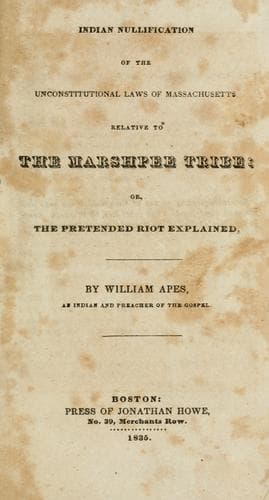
Indian Nullification of the Unconstitutional Laws of Massachusetts Relative to the Marshpee Tribe: Or, the Pretended Riot ExplainedApess, William
History
Indian Nullification of the Unconstitutional Laws of Massachusetts Relative to the Marshpee Tribe: Or, the Pretended Riot Explained
Apess, William
Indians of North America -- Legal status, laws, etc.; Mashpee Indians -- Land tenure; Mashpee Indians -- Legal status, laws, etc.
It should be understood that the Committee who reported the act of
1834, giving the new law to the Indians, did not decide any question
touching the parsonage. They treated all the plantation as lands owned
in common. It has been said that the Chairman of the Committee, Mr.
Barton, had given an opinion that Mr. Fish was entitled to hold
the property. This is incorrect. To obviate such an impression,
Mr. Hallett, the counsel for the Indians, wrote to Mr. Barton, and
received the following reply, which will fully explain the position in
which the question was left by the Legislature. In the views expressed
by Mr. Barton, Mr. Hallett fully concurs. Too much praise cannot be
given to Mr. Barton for the zeal, patience and ability with which he
discharged the duties of Chairman of the Committee.
WORCESTER, JULY 1, 1834.
DEAR SIR,
I last evening received your favor of the 28th ult. The Committee of
the Legislature, who had in charge the Marshpee business,
intentionally avoided expressing any opinion in regard to the tenure
by which Mr. Fish held the parsonage. In our report we merely
adverted to the facts, that in 1783, Lot Nye, and several Indians
granted 400 acres of the common land, "to be forever for the
important purpose of propagating the Gospel in Marshpee." There were
no grantees named in the deed. In 1809, the General Court confirmed
this grant of a parsonage, "to be held forever for a Congregational
Gospel Minister." We found Mr. Fish in possession of the parsonage,
_as such a minister_. But whether by virtue of said grant, and his
settlement at Marshpee he could hold the parsonage, _as a sole
corporation_, we regarded it as a question of purely a judicial
character, and one with which it was "not _expedient_," and might we
not have added _proper_, "for the Legislature to interfere." If Mr.
Fish has rights under these grants, and by virtue of his settlement,
I know you will agree with me, that the Legislature can do nothing
to divest him of them. And if he had no such right, we were not
disposed to create them. I am entirely satisfied with the course
which the Committee took in relation to the parsonage; and the
circumstance that questions are now agitated in relation to it, show
that in one particular, at least, the Committee acted judiciously.
We left the parsonage precisely as we found it; leaving to another
branch of the government the appropriate responsibility of settling
all questions growing out of the grant of 1783, the confirmation of
1809, and the settlement of Mr. Fish. Could we by legislation settle
those questions, it might have been our duty to do so, for the
sake of the harmony of the District. But it seems to me that any
such attempt would have had a tendency to create new difficulties,
rather than to diminish old ones.
Public-domain text, read in full here on John Shaqi.
Reviews
Reviews
No reviews yet
Be the first to share your thoughts on this work.
Elsewhere in the archive
Join the Discussion
Join the discussion
Sign in to leave a comment or review.
Sign InorCreate an account