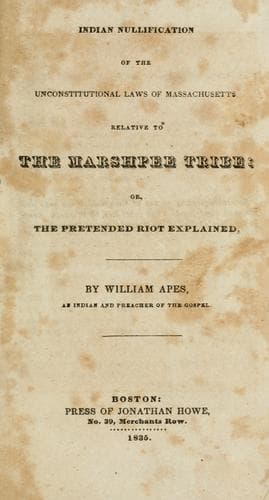
Indian Nullification of the Unconstitutional Laws of Massachusetts Relative to the Marshpee Tribe: Or, the Pretended Riot ExplainedApess, William
History
Indian Nullification of the Unconstitutional Laws of Massachusetts Relative to the Marshpee Tribe: Or, the Pretended Riot Explained
Apess, William
Indians of North America -- Legal status, laws, etc.; Mashpee Indians -- Land tenure; Mashpee Indians -- Legal status, laws, etc.
I use these pieces chiefly because they partly correspond in truth
and spirit with what I have already said. Let our friends but read the
laws, and they will see what the sword of the Commonwealth is intended
for. In the second article there is a grievous mistake. It says that
the government has assisted us. The Marshpee Indians have always paid
their full share of taxes, and very great ones they have been. They
have defrayed the expense of two town meetings a year, and one of two
of the white men whose presence was necessary, lived twenty-five miles
off. The meetings lasted three or four days at a time, during which,
these men lived upon the best, at our cost, and charged us three
dollars a day, and twenty-five cents a mile, travelling expenses,
going and coming into the bargain. This amounts to thirty-five dollars
a trip; and as there were, as has already been said, two visitations a
year, it appears that we have paid seventy dollars a year to bring one
visitor, whose absence would have been much more agreeable to us than
his presence. Extend this calculation to the number of seven persons,
and the other expenses of our misgovernment, and perhaps some other
expenditures not mentioned, and see what a sum our tax will amount to.
The next article is from the Boston Advocate of December 27, 1833.
THE MARSHPEE INDIANS.
It was stated in the Barnstable Journal the other day, and has
been copied into other papers, that the Marshpee Indians
were generally satisfied with their situation, and desired no
change, and that the excitement, produced principally by
Mr. Apes, had subsided. We had no doubt this statement was
incorrect, because we had personally visited most of the
tribe, in their houses and wigwams, in August last, and found
but one settled feeling of wrong and oppression pervading the
whole; not a new impulse depending upon Mr. Apes or any other
man, but the result of the unjust laws which have ruled them
like a complete despotism.
The Overseers are not so much to blame as the laws. We doubt
not they have acted honestly; but, in the spirit of the laws,
they have almost unavoidably exercised a stern control over
the property and persons of the tribe. In fact the laws, as
they now stand, almost permit the Overseers, with impunity,
to sell the Indians for slaves. They can bind them out as they
please, do as they please with their contracts, expel them
from the plantation almost at will, and in fact use them
nearly as slaves. We do not think they have intentionally done
wrong to the Indians, but the whole system of government is
wrong; and hence the unalterable dislike the Indians have to
their Overseers. No better men could be appointed, that
we know of; but the best men must play the tyrant, if they
execute the present laws, designed as they are to _oppress_,
and not to protect the poor Indians.
Public-domain text, read in full here on John Shaqi.
Reviews
Reviews
No reviews yet
Be the first to share your thoughts on this work.
Join the Discussion
Join the discussion
Sign in to leave a comment or review.
Sign InorCreate an account