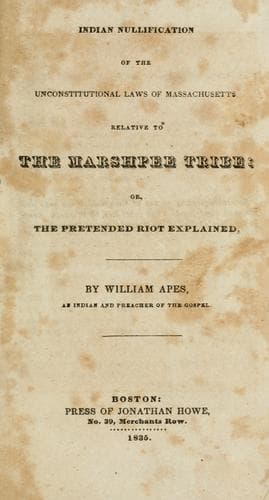
Indian Nullification of the Unconstitutional Laws of Massachusetts Relative to the Marshpee Tribe: Or, the Pretended Riot ExplainedApess, William
History
Indian Nullification of the Unconstitutional Laws of Massachusetts Relative to the Marshpee Tribe: Or, the Pretended Riot Explained
Apess, William
Indians of North America -- Legal status, laws, etc.; Mashpee Indians -- Land tenure; Mashpee Indians -- Legal status, laws, etc.
We have known these Indians, from our youth up. They live near
our native home. The first pleasure we ever derived from the
exercise of benevolence, was in satisfying the calls of their
women and children for bread, at our father's door, and we
always found them kind hearted to those who were kind to
them. We have often met with them to worship in their rural
meeting-house, and have again and again explored with the
angling rod, the romantic stream, abounding with the nimble
trout, which courses through their plantation.
For those reasons, and these alone, we felt it our duty to
give them an opportunity to be heard through the columns of
our paper, while all others were closed to them, or cold to
their complaints. If we can do them any good, we shall have
a full reward in the act itself. We have it already in the
simple tribute of gratitude, which they have unexpectedly
bestowed upon our poor services.
They have sent us a communication, which is signed by the best
men in the tribe. We know most of these names, and they belong
to the most sensible and most industrious to be found on the
plantation. Will other papers publish this simple appeal to
the justice of the white men? It is useless to say after this,
that the Indians of Marshpee are content with their condition.
Something must be done for them.
MARSHPEE INDIANS.
"MR. HALLETT,
It has been stated in some of the papers that the Marshpee
Indians are generally satisfied with their situation, and the
conduct of the Overseers, and want no change. It is also said
that the most industrious men on the plantation are opposed
to petitioning the Legislature to give them the management of
their own property; and they would all have been quiet, if it
had not been for Mr. Apes.
Now we know something of our own rights without being told by
Mr. Apes, or any one. We have confidence in Mr. Apes, and
have seen no reason to doubt that he means well; but our
dissatisfaction with the laws and the Overseers was the same
as it is now, long before Mr. Apes came among us, and he will
have our confidence no longer than while we are satisfied he
does right. If he does wrong, we shall oppose him as soon as
any man, but so long as he honestly aids us in seeking for our
rights, we shall be in his favor. He is only one of us, and
has no more authority over the tribe than any other member
of it. He has been adopted into the tribe, according to the
Indian custom; and as long as he deserves our confidence, we
shall regard him as a friend.
Public-domain text, read in full here on John Shaqi.
Reviews
Reviews
No reviews yet
Be the first to share your thoughts on this work.
Join the Discussion
Join the discussion
Sign in to leave a comment or review.
Sign InorCreate an account