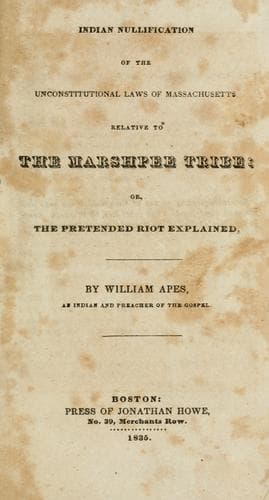
Indian Nullification of the Unconstitutional Laws of Massachusetts Relative to the Marshpee Tribe: Or, the Pretended Riot ExplainedApess, William
History
Indian Nullification of the Unconstitutional Laws of Massachusetts Relative to the Marshpee Tribe: Or, the Pretended Riot Explained
Apess, William
Indians of North America -- Legal status, laws, etc.; Mashpee Indians -- Land tenure; Mashpee Indians -- Legal status, laws, etc.
The address at the State House last Friday evening was also
attended by an overflowing house. We were unable to get in,
and cannot, therefore, say what effect was produced by it.
The next is from the Liberator of Jan. 25, 1834.
THE MARSHPEE INDIANS.
This is a small tribe, comprising four or five hundred
persons, residing at the head of Cape Cod, in Barnstable
County. They have long been under the guardianship of the
State, treated as paupers, and subjected to the control of a
Board of Overseers. A memorial from them was presented to
the Legislature last week, (written entirely by one of their
number,) in which they set forth the grievances which are
imposed upon them, the injustice and impolicy of the laws
affecting their tribe, the arbitrary and capricious conduct of
the Overseers, and the manner in which they are defrauded
of the fruits of their labor; and earnestly beseech the
Legislature to grant them the same liberty of action as is
enjoyed by their white brethren, that they may manage their
own concerns, and be directly amenable to the laws of the
State, and not to their present Overseers.
A delegation from this tribe is now in this city, consisting
of Deacon Coombs, Daniel Amos, and William Apes. The use of
the Hall of the House of Representatives having been granted
to them, they made a public statement of their situation
and wants to a crowded audience on Friday evening last,
principally composed of members of the House; and were
listened to most respectfully and attentively.
Deacon Coombs first addressed the assembly, in a brief but
somewhat indefinite speech; the purport of which was, that,
although by taking side with the Overseers, he might have
advanced his own interests, he nevertheless chose to suffer
with his people, and to plead in their behalf. Their condition
was growing more and more intolerable; excessive exactions
were imposed upon them; their industry was crippled by
taxation; they wished to have the Overseers discharged.
Public-domain text, read in full here on John Shaqi.
Reviews
Reviews
No reviews yet
Be the first to share your thoughts on this work.
Elsewhere in the archive
Join the Discussion
Join the discussion
Sign in to leave a comment or review.
Sign InorCreate an account