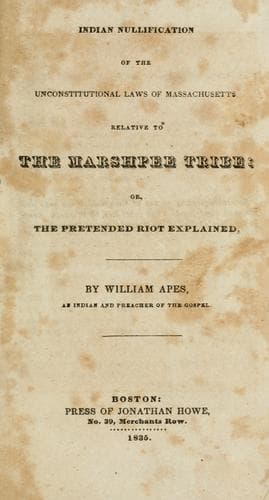
Indian Nullification of the Unconstitutional Laws of Massachusetts Relative to the Marshpee Tribe: Or, the Pretended Riot ExplainedApess, William
History
Indian Nullification of the Unconstitutional Laws of Massachusetts Relative to the Marshpee Tribe: Or, the Pretended Riot Explained
Apess, William
Indians of North America -- Legal status, laws, etc.; Mashpee Indians -- Land tenure; Mashpee Indians -- Legal status, laws, etc.
Daniel Amos next addressed the meeting. He said he was aware
of his ignorance; but although his words might be few, and his
language broken, he as deeply sympathized with his suffering
constituents, as any of his tribe. He gave a short sketch of
his life, by which it appeared that he went at an early period
on a whaling voyage, and received some bodily injury which
incapacitated him from hard labor for a long time. He sought
his native home, and soon experienced the severity of those
laws, which, though enacted seemingly to protect the tribe,
are retarding their improvement, and oppressing their spirits.
The present difficulties were not of recent origin. He stated,
with commendable pride, that he had never been struck for
ill-behaviour, nor imprisoned for crime or debt; nor was he
ashamed to show his face again in any place he had visited;
and he had been round a large portion of the globe. The
memorial before the Legislature had been read to the tribe;
some parts had been omitted at their request; and nothing had
been sent but by their unanimous consent. After vindicating
the character of Mr. Apes, and enumerating some of the
complaints of the tribe.
He was followed by William Apes, who, in a fearless,
comprehensive and eloquent speech, endeavored to prove that,
under such laws and such Overseers, no people could rise
from their degradation. He illustrated the manner in which
extortions were made from the poor Indians, and plainly
declared that they wanted their rights as men and as freemen.
Although comparatively ignorant, yet they knew enough to
manage their own concerns more equitably and economically than
they were then managed; and notwithstanding the difficulties
under which they labored, their moral condition was improving.
There was not so much intemperance among them as formerly;
many of the tribe were shrewd, intelligent and respectable
men; and all that was necessary to raise up the entire mass
from their low estate, was the removal of those fetters
and restrictions which now bind them to the dust. Mr. Apes
described the cause and the extent of the disturbance
which took place last summer, and which resulted in his
imprisonment. The head and front of their offending was in
going into the woods, and unloading a cart, and causing it to
be sent away empty. The reason for that procedure was, that
they wished no more wood to be cut until an investigation of
their rights had been made. They used no violence; uttered no
oaths; made no throats; and took no weapons of defence. Every
thing was done quietly, but firmly. Mr. Apes wished to know
from whence the right to tax them without their consent, and
at pleasure, and subject them to the arbitrary control of a
Board of Overseers, was derived? He knew not himself; but he
Public-domain text, read in full here on John Shaqi.
Reviews
Reviews
No reviews yet
Be the first to share your thoughts on this work.
Elsewhere in the archive
Join the Discussion
Join the discussion
Sign in to leave a comment or review.
Sign InorCreate an account