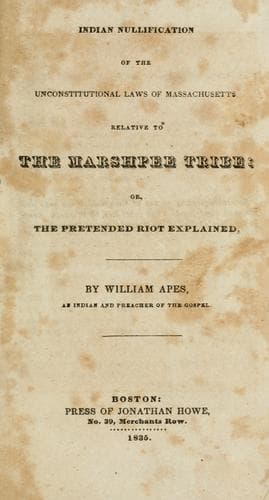
Indian Nullification of the Unconstitutional Laws of Massachusetts Relative to the Marshpee Tribe: Or, the Pretended Riot ExplainedApess, William
History
Indian Nullification of the Unconstitutional Laws of Massachusetts Relative to the Marshpee Tribe: Or, the Pretended Riot Explained
Apess, William
Indians of North America -- Legal status, laws, etc.; Mashpee Indians -- Land tenure; Mashpee Indians -- Legal status, laws, etc.
This gentleman swore in court that he thought Indians an inferior race
of men; and, of course, were incapable of managing their own affairs.
The testimony of the two decoy pigeons was, that they had liberty
enough; more than they knew what to do with. They showed plainly
enough that they knew nothing of the law they lived under. The
testimony of the Rev. Mr. Fish was more directly against us. Some may
think I do wrong to mention this gentleman's name so often. But why,
when a man comes forward on a public occasion, should his name be kept
out of sight, though he be a clergyman. I should think he would like
to make his flock respected and respectable in his speech, which he
well knew they never could be under the then existing laws. Is it
more than a fair inference that it was self-interest that made him
do otherwise, that he might be able to continue in possession of his
strong hold? If he had said to the Indians, like an honest man, "I
know I have no right to what is yours, and will willingly relinquish
what I hold of it," I do not doubt that the Indians would have given
him a house, and a life estate in a farm; and perhaps have conveyed it
to him in fee simple, if he had behaved well. Such a course would have
won him the love and esteem of the Indians, and his blind obstinacy
was certainly the surest means he could have taken to gain their ill
will. He may think slightly of their good opinion, and I think, from
his whole course of conduct, that we are as dogs in his sight. I
presume he could not die in peace if he thought he was to be buried
beside our graves.
It is the general fault of those who go on missions, that they cannot
sacrifice the pride of their hearts, in order to do good. It seems to
have been usually the object to seat the Indians between two stools,
in order that they might fall to the ground, by breaking up their
government and forms of society, without giving them any others in
their place. It does not appear to be the aim of the missionaries to
improve the Indians by making citizens of them. Hence, in most cases,
anarchy and confusion are the results. Nothing has more effectually
contributed to the decay of several tribes than the course pursued by
their missionaries. Let us look back to the first of them for proofs.
From the days of Elliott, to the year 1834, have they made one
citizen? The latter date marks the first instance of such an
experiment. Is it not strange that free men should thus have been
held in bondage more than two hundred years, and that setting them at
liberty at this late day, should be called _an experiment_ now?
Public-domain text, read in full here on John Shaqi.
Reviews
Reviews
No reviews yet
Be the first to share your thoughts on this work.
Elsewhere in the archive
Join the Discussion
Join the discussion
Sign in to leave a comment or review.
Sign InorCreate an account