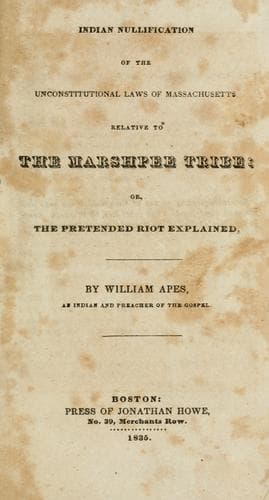
Indian Nullification of the Unconstitutional Laws of Massachusetts Relative to the Marshpee Tribe: Or, the Pretended Riot ExplainedApess, William
History
Indian Nullification of the Unconstitutional Laws of Massachusetts Relative to the Marshpee Tribe: Or, the Pretended Riot Explained
Apess, William
Indians of North America -- Legal status, laws, etc.; Mashpee Indians -- Land tenure; Mashpee Indians -- Legal status, laws, etc.
Is not the conclusion then, from all the facts in the case,
that the system of laws persisted in since 1763, have failed
as acts of paternal care? That the true policy now is to try
acts of kindness and encouragement, and that the question of
rightful control over the property or persons of the Indians
beyond the general operation of the laws, being clearly
against the whites; but one consideration remains on which the
Legislature can hesitate: the danger, that they will squander
their property. Of the improbability of such a result, Mr.
Fiske informs you in his report, [page 26.] He found nearly
all the families comfortably and decently clad, nearly
all occupying framed houses, and a few dwelling in huts or
wigwams. More than thirty of them were in possession of a cow
or swine, and many of them tilled a few acres of land, around
their dwellings. Several pairs of oxen, and some horses are
owned on the plantation, and the Commons are covered with an
excellent growth of wood, of ready access to market. Confine
the cutting of this wood to the natives, as they desire, and
they never can waste this valuable inheritance.
Mr. Fiske also says in his report, [page 30,] "that it is
hardly possible to find a place more favorable for gaining a
subsistence without labor, than Marshpee." The advantages of
its location, the resources from the woods and streams, on one
side, and the bays and the sea on the other, are accurately
described, as being abundant, with the exception of the
_lobsters_, which Mr. Fiske says are found there. The
Commissioner is incorrect in that particular, unless he adopts
the learned theory of Sir Joseph Banks, that _fleas_ are a
species of lobster!
Is there, then, any danger in giving the Indians an
opportunity to try a liberal experiment for self-government?
They ask you for a grant of the liberties of the constitution;
to be incorporated and to have a government useful to them as
a people.
Public-domain text, read in full here on John Shaqi.
Reviews
Reviews
No reviews yet
Be the first to share your thoughts on this work.
Elsewhere in the archive
Join the Discussion
Join the discussion
Sign in to leave a comment or review.
Sign InorCreate an account