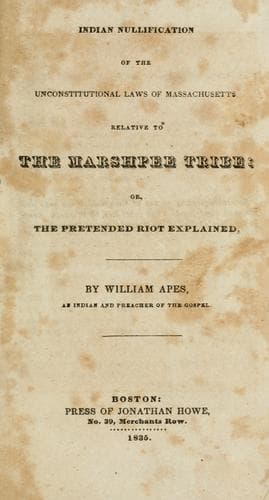
Indian Nullification of the Unconstitutional Laws of Massachusetts Relative to the Marshpee Tribe: Or, the Pretended Riot ExplainedApess, William
History
Indian Nullification of the Unconstitutional Laws of Massachusetts Relative to the Marshpee Tribe: Or, the Pretended Riot Explained
Apess, William
Indians of North America -- Legal status, laws, etc.; Mashpee Indians -- Land tenure; Mashpee Indians -- Legal status, laws, etc.
In all twenty-six men. The whole regiment, drawn from the
whole County of Barnstable, mustered but 149 men, nearly
_one-fifth_ of whom were volunteers from the little Indian
Plantation of Marshpee, which then did not contain over one
hundred male heads of families! No white town in the
County furnished any thing like this proportion of the 149
volunteers. The Indian soldiers fought through the war; and as
far as we have been able to ascertain the fact, from documents
or tradition, all but one, fell martyrs to liberty, in the
struggle for Independence. There is but one Indian now living,
who receives the reward of his services as a revolutionary
soldier, old Isaac Wickham, and he was not in Bradford's
regiment. Parson Holly, in a memorial to the Legislature in
1783, states that most of the women in Marshpee, had lost
their husbands in the war. At that time there were _seventy_
widows on the Plantation.
But from that day, until the year 1834, the Marshpee Indians
were enslaved by the laws of Massachusetts, and deprived of
every civil right which belongs to man. White Overseers had
power to tear their children from them and bind them out where
they pleased. They could also sell the services of any adult
Indian on the Plantation they chose to call idle, for three
years at a time, and send him where they pleased, renewing the
lease every three years, and thus, make him a slave for life.
It was with the greatest effort this monstrous injustice was
in some degree remedied last winter, by getting the facts
before the Legislature, in spite of a most determined
opposition from those who had fattened for years on the spoils
of poor Marshpee. In all but one thing, a reasonable law was
made for the Indians. That one thing was giving the Governor
power to appoint a Commissioner over the Indians for three
years. This was protested against by the friends of the
Indians, but in vain; and they were assured that this
appointment would be safe in the hands of the Governor. They
hoped so, and assented; but no sooner was the law passed, than
the enemies of the Indians induced the Governor to appoint
as the Commissioner, the person whom of all others they least
wished to have, a former Overseer, against whom there were
strong prejudices. The Indians remonstrated, and besought, but
in vain. The Commissioner was appointed, and to all appeals to
make a different appointment, a deaf ear has been turned. It
seems as if a deliberate design had been formed somewhere, to
defeat all the Legislature has done for the benefit of this
oppressed people.
Public-domain text, read in full here on John Shaqi.
Reviews
Reviews
No reviews yet
Be the first to share your thoughts on this work.
Elsewhere in the archive
Join the Discussion
Join the discussion
Sign in to leave a comment or review.
Sign InorCreate an account