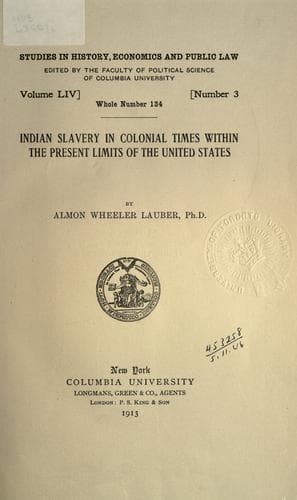
Indian slavery in colonial times within the present limits of the United StatesLauber, Almon Wheeler
History
Indian slavery in colonial times within the present limits of the United States
Lauber, Almon Wheeler
Indians of North America; Indians, Treatment of -- United States; Slavery -- United States; Thesis (Ph. D.)
Indian slaves, among the aborigines, 25–47;
among the Spaniards, 48–62;
among the French, 63–102;
among the English, 102–319;
in the Carolinas, 66–108;
in Georgia, 108;
in Virginia, 108;
in Massachusetts, 109–110;
in Rhode Island, 110;
in Connecticut, 110–111;
in New Hampshire, 111;
in New Netherland, 112–113;
in New York, 113;
in Pennsylvania, 115;
in New Jersey, 116;
in Maryland, 117;
by warfare, 118–153;
war with Stono Indians, 119;
war with Kussoe Indians, 119;
war of Spanish succession, 119;
Tuscarora War, 121;
Pequot War, 123;
King Philip’s War, 125;
Bacon’s rebellion, 131;
disposed of by colonial governments, 132–152;
by kidnapping, 154–167;
by trade, 168–195;
sold by family or tribe, 196;
abuse of apprenticeship, 198–201;
punishment, 201;
birth, 207–210;
considered property, 211–241;
bought and sold, 216;
advertised for sale, 216;
disposed of by will, 216;
runaways advertised, 218, 219;
disputes concerning, settled by court, 225;
personal property, 226;
real property, 226;
regarded as taxables, 227–228;
import and export duties on, 233;
as hunters, fishermen and guides, 242;
employed in fields, 244–245;
in manual occupations, 245;
hired out by owners, 245;
in military occupations, 246–249;
captured by French from English army, 246;
included by implication in legislative acts relating to slaves, 253;
right to testify in court, 254–255;
granted right to life, 255;
prohibitions on, 259, 260;
punishments, 260–264;
religious instruction of, 264–275;
manumission, 57, 94–95, 276–282;
freed by owner, 276;
purchase freedom, 276;
regulation of actions after emancipation, 280;
decline of use of, 283–319;
poor domestics, 288;
implicated in slave disturbances, 289;
included in laws concerning slaves by implication, 290;
values of, 298–302;
less valuable than negroes, 302;
use of, abolished in Virginia, 312;
in South Carolina, 315;
in Rhode Island, 316;
in New York, 317
Iroquois, tribe, 27, 28, 29, 31, 34, 35, 36, 37, 38, 41;
effect on Indian slavery, 117
Ipswich, slaves in, 109, 298
Jenney, Reverend, on Indian slaves, 114, 273
Jesuits, 27, 34, 35, 41, 42;
oppose sale of Indians, 78, 79;
enslaved by Iroquois, 47
Johnson, missionary in South Carolina, on Indian slaves, 121
Johnson, Nathaniel, governor of Carolina, 106;
report on condition of Carolina, 106;
refuses to sell Indian perquisites, 183
Johnson, Robert, governor of Carolina, makes peace between nations,
172
Johnson, William, on Indian slaves in New York, 114
Jolliet, given an Indian, 80
Jones, Reverend Hugh, on baptizing Indian and negro slaves, 271
Jordan, river, 53
Joutel, 37
Judicial decisions recognize children of slave mothers as slaves, 210
Public-domain text, read in full here on John Shaqi.
Reviews
Reviews
No reviews yet
Be the first to share your thoughts on this work.
Elsewhere in the archive
Join the Discussion
Join the discussion
Sign in to leave a comment or review.
Sign InorCreate an account