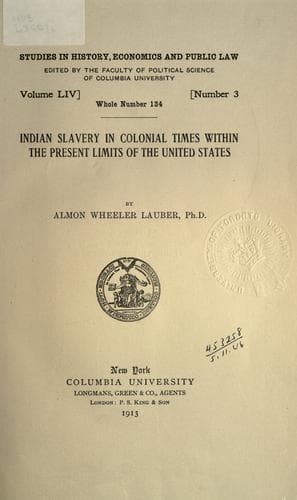
Indian slavery in colonial times within the present limits of the United StatesLauber, Almon Wheeler
History
Indian slavery in colonial times within the present limits of the United States
Lauber, Almon Wheeler
Indians of North America; Indians, Treatment of -- United States; Slavery -- United States; Thesis (Ph. D.)
An interesting example of such manumission is recorded in Louisiana in
1770. On April 30th of that year, the Sieur Pierre Clermont appeared
before the notary of the Cabildo and declared that he had had for a
long time in his service an Indian, Louison, of the nation of the
“Sious.” The latter had served him with so much attachment and zeal
that he desired to reward him, and believed that the best way to do
so was to give him his freedom. As, however, he had an indispensable
need for the Indian for three years longer, and feared that he might
be prevented by death from liberating him, he stated that it was his
wish that in three years Louison be set free and enjoy all the rights
of freedom. Louison, in his turn, stated that he thanked the Sieur
Clermont, and promised to serve him faithfully for three years. He
also agreed to lose all rights given him by his master if he should
be ungrateful to him. Fortier, _Old Papers of Colonial Times_, in
_Louisiana Historical Society Publications_, i, pt. ii, 1895, p. 17.
[312] _Mississippi Provincial Archives, French Domination,
Correspondance Générale_, 1716, vi, p. 355.
[313] _Ibid._, 1721–1722, x, p. 217; _Archives du Ministre des
Colonies_, C. 13, vi, p. 368.
[314] Hewat, _An Historical Account of the Rise and Progress of the
Colonies of South Carolina and Georgia_, ii, p. 227.
[315] Wilson, _A New History of the Conquest of Mexico_, p. 34.
[316] Dunn, _Indiana_, p. 126.
[317] Carver, _Travels through the Interior Parts of North America_,
etc., p. 348.
[318] Salone, _La Colonisation de la Nouvelle-France_, deuxième
édition, p. 353.
[319] In 1793, slavery was abolished in Upper Canada by act of the
Provincial Parliament. In Lower Canada, it had practically ceased by
1800, the few remaining slaves being freed by an imperial act in 1834.
_Jesuit Relations_, lxix, p. 301. The last public sale of a slave in
Canada took place in Montreal in 1797. It has been held, however, that
it was the proceeding of the Canadian courts, consistent with the
rising public sentiment in England and France against slavery, rather
than the actual state of the law, which reached the slave owners’
claims, and finally broke them. Hamilton, _Slavery in Canada_, in
_Transactions of the Canadian Institute_, 1890, i, p. 102.
[320] _Archives Nationales, Colonies_, C. 13, _Louisiane,
Correspondance Générale_, i, 1678–1706, p. 514; Gayarré, _History of
Louisiana_, i, p. 100.
[321] _Mississippi Provincial Archives, French Domination,
Correspondance Générale_, viii, 1717–1720, pp. 73–74.
[322] _Mississippi Provincial Archives, French Domination,
Correspondance Générale_, xvii, pp. 303–307.
[323] _Report Concerning Canadian Archives_, 1905, i, p. 117.
[324] John Long’s _Journal_, 1768–1782, in Thwaites, _Early Western
Travels_, ii, p. 116.
Public-domain text, read in full here on John Shaqi.
Reviews
Reviews
No reviews yet
Be the first to share your thoughts on this work.
Elsewhere in the archive
Join the Discussion
Join the discussion
Sign in to leave a comment or review.
Sign InorCreate an account