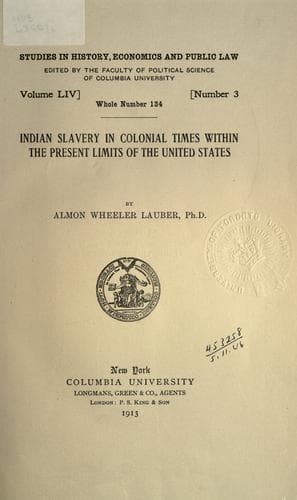
Indian slavery in colonial times within the present limits of the United StatesLauber, Almon Wheeler
History
Indian slavery in colonial times within the present limits of the United States
Lauber, Almon Wheeler
Indians of North America; Indians, Treatment of -- United States; Slavery -- United States; Thesis (Ph. D.)
[850] Allinson, _Acts of the General Assembly of the Province of New
Jersey_, p. 31. By the terms of the act, the duty was to continue seven
years, beginning June 1, 1714.
[851] _New Jersey Archives_, first series, xv, p. 30.
[852] _Ibid._, first series, xv, p. 351.
[853] _Ibid._, first series, xv, pp. 384, 385.
[854] Allinson, _Acts of the General Assembly of the Province of New
Jersey_, p. 315.
[855] Ballagh, _op. cit._, p. 14.
[856] Pennsylvania, January 12, 1706, passed an act for the purpose
of meeting government expenses. Negroes were enumerated among the
commodities on which duties were laid. No mention was made of Indians.
_Pennsylvania Statutes at Large_, ii, p. 280.
[857] _New York Colonial Laws_, edition of 1894, i, pp. 484, 487.
[858] _Ibid._, i, p. 588.
[859] _Ibid._, i, p. 1013.
[860] _Ibid._, i, p. 677. On October 11, 1709, the act was amended with
regard to its enforcement. _Ibid._, i, p. 736.
[861] _Ibid._, i, p. 803.
[862] _Ibid._, i, p. 899.
[863] _New York Colonial Laws_, edition of 1894, i, p. 1012.
[864] _Ibid._, ii, pp. 255, 310.
[865] _Ibid._, ii, p. 772.
[866] _Ibid._, ii, p. 877.
[867] _Ibid._, ii, p. 1048.
[868] _Ibid._, ii, p. 1049.
[869] _New York Colonial Laws_, edition of 1894, ii, p. 1049. The act
also provided technical arrangements for settling disputes regarding
the ages of the slaves, the exemption from duty if the slave should die
within a period of thirty days after arrival, the receipt issued for
such duty by the treasurer, and precautions to prevent smuggling.
[870] _Ibid._, iii, p. 2.
[871] _Ibid._, iii, p. 32.
[872] _Ibid._, iii, p. 88.
[873] _Ibid._, iii and iv. New York, like Virginia, sought to avoid
the veto of the home government to these laws by giving them a short
term of existence, usually one year. And generally New York was more
successful than Virginia. But the home government was not always
satisfied by such provisions as is witnessed by the Privy Council’s
rejection of the act of 1735 levying a duty on negro and Indian slaves,
_New York Colonial Documents_, vi, p. 33.
[874] _The Statutes at Large of South Carolina_, ii, p. 201. Duties
were also levied by the act upon skins and furs.
[875] _Indian Book_, 1710–1718, in Columbia, South Carolina, Historical
Commission Department, i, p. 19.
[876] Hawks, _History of North Carolina_, etc., second edition, ii, p.
229; Brickell, _The Natural History of North Carolina_, etc., p. 42.
[877] Hewat, _op. cit._, i, p. 128; Schaper, _Sectionalism in South
Carolina_, p. 283.
[878] Cotton Mather kept an Indian prisoner to serve as a guide.
_Magnalia_, edition of 1820, ii, p. 507.
[879] Lyford, _History of Concord, New Hampshire, from the Original
Grant_, etc., ii, p. 1051; Goodwin, _The Pilgrim Republic_, p. 191.
Public-domain text, read in full here on John Shaqi.
Reviews
Reviews
No reviews yet
Be the first to share your thoughts on this work.
Elsewhere in the archive
Join the Discussion
Join the discussion
Sign in to leave a comment or review.
Sign InorCreate an account