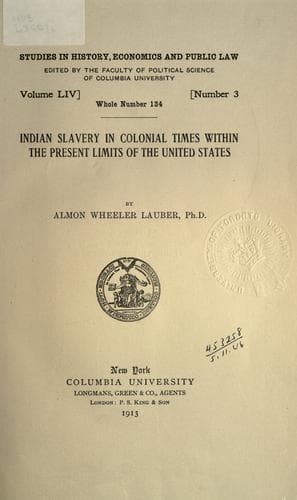
Indian slavery in colonial times within the present limits of the United StatesLauber, Almon Wheeler
History
Indian slavery in colonial times within the present limits of the United States
Lauber, Almon Wheeler
Indians of North America; Indians, Treatment of -- United States; Slavery -- United States; Thesis (Ph. D.)
[1120] Jefferson, _Notes on the State of Virginia_, edition of 1787, p.
153.
[1121] _Ibid._, edition of 1787, pp. 154, 155.
[1122] Letter of Samuel Thomas, missionary in South Carolina of the
Society for the Propagation of the Gospel in Foreign Parts, 1706, in
_South Carolina Historical and Genealogical Magazine_, 1904, v, p. 42;
Letter of Henry Laurens, 1780, in Moore, _Materials for History printed
from Original Manuscripts with Notes and Illustrations_, p. 187.
[1123] Archdale, _op. cit._, in Carroll, _op. cit._, ii, pp. 88–89.
[1124] _Ibid._, ii, p. 89.
[1125] It is perhaps true that the Indians of the territory occupied
by the English colonists of America possessed certain inherent
characteristics which made them less desirable as servants or slaves
than those used by the Spaniards in Mexico and South America, and that
they had less fear and dread of the whites than the Indians farther
south.
[1126] Mason, _A Brief History of the Pequot War_, etc., in Orr, _op.
cit._, p. 39.
[1127] Mayhew, _Indian Converts_, p. 26.
[1128] Daniels, _History of the Town of Oxford, Massachusetts_, p. 44.
[1129] Dorr, _The Narragansetts_, in _Rhode Island Historical Society
Collections_, vii, p. 210; Wood, _New England’s Prospect_, Prince
Society edition, p. 73.
[1130] Dorr, _op. cit._, in _Rhode Island Historical Society
Collections_, vii, p. 233.
[1131] Force, _Tracts and other Papers relating principally to the
Origin, Settlement and Progress of the Colonies in North America_,
etc., i, p. 10.
[1132] _The Statutes at Large of South Carolina_, vii, p. 343. Other
acts were passed by South Carolina in 1712, 1735, 1740, 1743, and 1783,
relating to slave conspiracies and uprisings. The omission in these
acts of direct reference to Indian slaves is probably due to the fact
that negro slaves were in the majority.
[1133] _Ibid._, iii, p. 196.
[1134] _Acts and Resolves_, i, p. 535.
[1135] _Acts and Laws of Connecticut_, edition of 1769, p. 185; Dillon,
_Oddities in Colonial Legislation_, p. 242.
[1136] _New York Colonial Laws_, edition of 1894, i, p. 631. New York
passed other laws in 1712 and 1730 relating to the uprisings and
conspiracy of slaves.
[1137] Watson, _Annals of Philadelphia_, i, p. 62.
[1138] See above, pp. 233–240.
[1139] _Acts and Resolves_, i. p. 698.
[1140] _Connecticut Colonial Records_, v, p. 233.
[1141] _Laws of New Hampshire_, edition of 1771, p. 53.
[1142] _Records of Rhode Island and Providence Plantations_, iv, pp.
193–194.
[1143] _Report of a French Protestant Refugee in Boston, 1687_,
Fisher’s translation, p. 20.
[1144] Winsor, _The Memorial History of Boston_, i, p. 489.
[1145] Hening, _op. cit._, ii, p. 143. For a petition, October 25,
1711, to Governor Spotswood for such a permit to employ an Indian man
and woman, see _Calendar of Virginia State Papers_, i, p. 150.
[1146] Winthrop, _Journal_, i, p. 260, in _Original Narratives of Early
American History_.
Public-domain text, read in full here on John Shaqi.
Reviews
Reviews
No reviews yet
Be the first to share your thoughts on this work.
Elsewhere in the archive
Join the Discussion
Join the discussion
Sign in to leave a comment or review.
Sign InorCreate an account