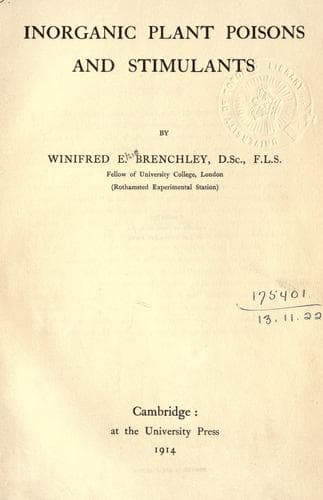
Inorganic Plant Poisons and StimulantsBrenchley, Winifred Elsie
Science
Inorganic Plant Poisons and Stimulants
Brenchley, Winifred Elsie
Growth (Plants); Plants -- Effect of poisons on
Loew (1883) was sceptical concerning the specific toxicity of arsenic for
plant protoplasm. He was convinced that arsenic and arsenious acid were
poisonous to algae, not because of their specific character as arsenical
compounds, but because of their acid nature, algae being peculiarly
sensitive to any acid, and he maintained that these substances were not
more poisonous than vinegar or citric acid. He placed various species
of _Spirogyra_ in solutions of ·2 gm. potassium arsenate per litre water
(1/5000), and found that the algae grew well without making any abnormal
growth in a fortnight, showing hardly one dead thread. Some of this
alga was then transferred to a 1/1000 solution of potassium arsenate.
This suited it excellently and it increased and the appearance under
the microscope was very fresh and strong, which was attributed more to
the potash than to the arsenic acid. Loew maintained that for the lower
animals and for many of the lower plants arsenic in the form of neutral
salts is not a poison. When the differentiation of the protoplasm into
certain organs reaches a specific degree in the higher plants, then the
poisonous action of the arsenic compounds comes into play.
Knop (1884) found that certain unicellular green algae grew luxuriantly
in a neutral solution supplied with potassium arsenate. Bouilhac (1894)
concerned himself chiefly with the possibility of the replacement of
phosphates by arsenates. He recognised that the influence of arsenic
is not the same on all species of plants, so he confined his attention
to certain of the algae. _Stichococcus bacillaris_ Naegeli was found
to live and reproduce itself in a mineral solution containing arsenic
acid. Even in the presence of phosphoric acid the arsenic acid favours
growth, the best dose being about 1/1000. The arsenic acid is capable of
partly replacing phosphoric acid. Other species of algae, _Protococcus
infusionum_, _Ulothrix tenerrima_, and _Phormidium Valderianum_ invaded
the original culture of Stichococcus from the atmosphere, but with no
arsenic or phosphoric acid their development was poor. The jars with
arsenic compounds were invaded by still more species which grew strongly.
Under these conditions it is evident that these algae are capable of
assimilating arsenic, and the addition of arsenic acid to a solution
free from phosphoric acid is sufficient to enable these algae to live
satisfactorily, the arsenates in this case replacing the phosphates.
Ono (1900) found that algae are favourably influenced by small doses of
poisons, the optimal quantity for algae being lower than that for fungi.
Protococcus showed a possible stimulus when grown in concentrations of
potassium arsenate varying from ·00002–·0005%. This possible stimulus is
interesting in view of the failure to observe stimulation in higher plants
by minute traces of arsenic.
2. _Fungi._
Public-domain text, read in full here on John Shaqi.
Reviews
Reviews
No reviews yet
Be the first to share your thoughts on this work.
Elsewhere in the archive
Join the Discussion
Join the discussion
Sign in to leave a comment or review.
Sign InorCreate an account