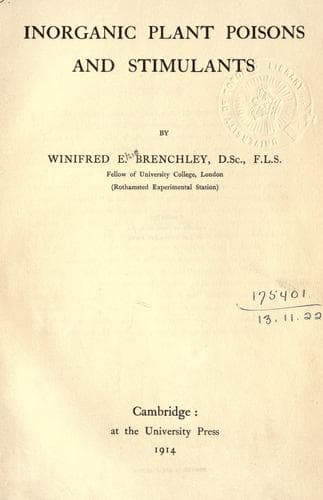
Inorganic Plant Poisons and StimulantsBrenchley, Winifred Elsie
Science
Inorganic Plant Poisons and Stimulants
Brenchley, Winifred Elsie
Growth (Plants); Plants -- Effect of poisons on
The effect of arsenic on fungi is of special interest in that it has a
direct bearing upon hygienic and commercial interests. Gosio (1892, 1897,
1901) found that certain of the fungi, _Mucor mucedo_ and _Aspergillus
glaucum_, will grow on various arsenic compounds and exercise a reducing
influence on them. These moulds attack all oxygen compounds of arsenic
including copper arsenite, and develope arsenical gases. Sulphur compounds
of arsenic are not influenced by these fungi. The same moulds would,
if cultivated in soil containing arsenic, develope hydrogen arsenide.
_Penicillium glaucum_ has such a strong and definite action on arsenic
compounds that he states that there is no doubt of the possibility of
poisoning by arsenical gas in a room hung with paper containing arsenic.
The compounds are so extraordinarily potent that if a mouse is placed
in a vessel in which the mould is strongly developed in the presence
of arsenic, it dies in a few seconds. _Penicillium brevicaule_ uses the
element in its development as a food substance. If material containing
arsenic is placed in contact with dead fungi no reaction occurs. The life
activity of the mould is evidently necessary for the reaction by which
the arsenic-containing gases are liberated. Csapodi (1894) put forward the
earlier results of Gosio and noted that the so-called arsenical fungicides
do not only fail to kill the mould fungi but actually favour their
development. This action explains why wallpaper containing arsenic is so
disadvantageous in a room. Abba (1898) severely tested Gosio’s method
of detecting arsenic by means of growths of _Penicillium brevicaule_,
whereby arsenic gases are liberated, vindicating the method completely,
and establishing the test as an exceptionally delicate one. Segale (1904)
applied the same method to the detection of the presence of arsenic in
animal tissues.
Ono (1900) grew Penicillium cultures with solutions of potassium arsenate
and found no important differences either of depression or stimulation.
Orlowski (1902–3) stated that small doses of arsenic (1/1000–1/100% Sodium
arsen--[11]) stimulate the growth of _Aspergillus niger_, larger doses up
to ⅛% retard growth, while ⅙% kills. Spores of the fungus taken from soil
containing arsenic are said to possess an immunity against arsenic, in
that they germinate in the presence of an arsenic content which rapidly
kills control fungi. This immunity is not specific for arsenic, but
extends also to other poisons. The chemical composition and water content
are not altered.
[11] The exact compound is not specified in the abstracted paper,
1/1000–1/100% Natr. Ars. being given.
_Conclusion._
Public-domain text, read in full here on John Shaqi.
Reviews
Reviews
No reviews yet
Be the first to share your thoughts on this work.
Elsewhere in the archive
Join the Discussion
Join the discussion
Sign in to leave a comment or review.
Sign InorCreate an account