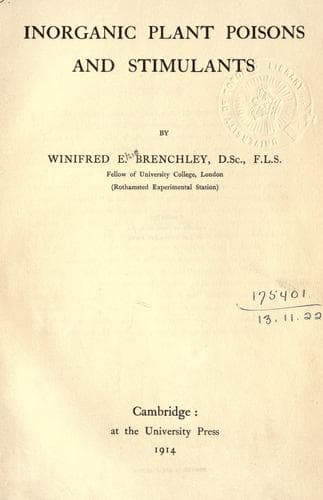
Inorganic Plant Poisons and StimulantsBrenchley, Winifred Elsie
Science
Inorganic Plant Poisons and Stimulants
Brenchley, Winifred Elsie
Growth (Plants); Plants -- Effect of poisons on
Tests with white lupins gave no conclusive results, as for some reason
it proved very difficult to get satisfactory plants in water cultures.
When they are grown under such conditions the roots always tend to get
more or less diseased and covered with slime, probably fungal in nature.
In the presence of much boric acid the roots remain in a much healthier
condition, which suggests that the acid has in this case a strong
antiseptic action, and protects the roots. With high concentrations
the lower leaves of the plant are badly affected, just as with peas and
barley, turning brown and withering at an early date. Various experiments
have been made with yellow lupins, but these again are very difficult to
grow well in water cultures, as they are apt to drop their leaves for no
apparent reason. Generally speaking, the evidence goes to prove that boric
acid is toxic down to a concentration of about 500 parts in 25 million.
It is difficult to get a true control with which to make comparisons
as the plants without boric acid are encumbered with the slime on their
roots, which naturally interferes with normal growth, while the plants in
the presence of boric acid have the unfair advantage due to the probable
antiseptic action of the boron. The effect of the boron poisoning is again
evident in the dying off of the lower leaves, which become flaccid and
drooping and finally drop off. The lupins grown with boron are very active
in the putting forth of lateral roots, so much so that the cortex of the
roots is split along the line of emergence of the laterals, which are very
numerous and crowded.
(_b_) _Toxic action of boron compounds in sand cultures._
Agulhon (1910 a) moistened 2 kgm. pure sand with 500 c.c. nutritive
solution for each pot, and boron was added at the rate of 0, 0·1, 1, 10,
and 50 mg. boric acid per litre of nutritive solution. Twenty wheat seeds
were sown in each pot, and after twelve days the healthy plants in the
first four pots were 6–8 cm. high, but those with the maximum amount of
boron showed yellowish leaves only 3 cm. long. After three months’ growth
the plants were harvested, when those with most boron were found to have
died after making about 10 cm. growth. The toxic doses in sand proved to
be weaker than those in water cultures, probably because evaporation from
the surface of the sand caused concentration of the poisonous liquid.
(_c_) _Toxic action of boron compounds in soil experiments._
Public-domain text, read in full here on John Shaqi.
Reviews
Reviews
No reviews yet
Be the first to share your thoughts on this work.
Elsewhere in the archive
Join the Discussion
Join the discussion
Sign in to leave a comment or review.
Sign InorCreate an account