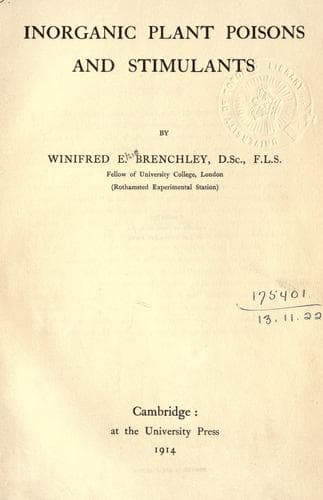
Inorganic Plant Poisons and StimulantsBrenchley, Winifred Elsie
Science
Inorganic Plant Poisons and Stimulants
Brenchley, Winifred Elsie
Growth (Plants); Plants -- Effect of poisons on
Interesting results were obtained (Agulhon 1910 a) by repeated experiments
with the same soil containing boron. It was found that sand or soil
containing a proportion of boron which is lethal or toxic to a first
culture will allow much better growth with a second and subsequent
crops. Repeated experiments on the same soil may show the change from a
lethal dose to a toxic one, thence to an indifferent and finally to an
optimum concentration. Furthermore (Agulhon 1910 b) the very plants may
accustom themselves to greater quantities of boron, the increased power
of resistance being transmitted. He concluded from his experiments that
the progeny of the second generation of maize were able to withstand
quantities of boron that were toxic to control plants[13]. Agulhon once
again emphasised the fact that for toxic doses of boron the first symptom
is the more or less marked disappearance of chlorophyll, though the aerial
parts are not affected so soon as the roots.
[13] “Il apparaît donc que les graines fournies par des plantes
ayant crû en présence d’une quantité de bore élevée présentent une
accoutumance vis-à-vis de cet élément; les plants auxquels elles
donnent naissance semblent non seulement faire un meilleur emploi
des petites doses de bore qui leur sont offertes, mais encore
supportent les doses toxiques plus facilement que les plants
témoins, issus de graines non accoutumées.”
2. _Effect of boron compounds on germination._
One of the first indications that boron compounds affect the germination
of seeds was given by Heckel (1875) who found that germination was
retarded for 1–3 days by weak solutions of borates (·25 gm. to 20 gm.
water), and was stopped altogether by stronger solutions (·60 gm. to 20
gm. water). Archangeli (1885) tested the germination of a variety of seeds
of Leguminosae, Gramineae, and of Cannabis, Iberis, Raphanus, Collinsia,
and Linum in the presence of boric acid. The seeds were placed in bowls
with solutions of ·25, ·5, and 1% boric acid at temperatures ranging from
16°–23° C. The bowls were covered with glass plates to prevent evaporation
and consequent increase of concentration, controls in spring water being
dealt with under similar conditions. 1% boric acid was found to check
germination altogether, and the weaker the concentration the less was
the process hindered. Morel soaked seeds of haricots and wheat in various
solutions of boric acid, and found that germination was generally hindered
or inhibited. The deleterious action diminishes as the strength of the
solution or the time of contact diminishes, but solutions of the same
concentration do not act equally on all seeds. Boric acid and borax proved
to be similar in their action qualitatively.
The deleterious effect of strong doses of boric acid on germination was
confirmed by Agulhon (1910 a), the higher quantities (above 10 mg. boric
acid per litre) retarding germination of wheat.
3. _Does boron stimulate higher plants?_
Public-domain text, read in full here on John Shaqi.
Reviews
Reviews
No reviews yet
Be the first to share your thoughts on this work.
Elsewhere in the archive
Join the Discussion
Join the discussion
Sign in to leave a comment or review.
Sign InorCreate an account