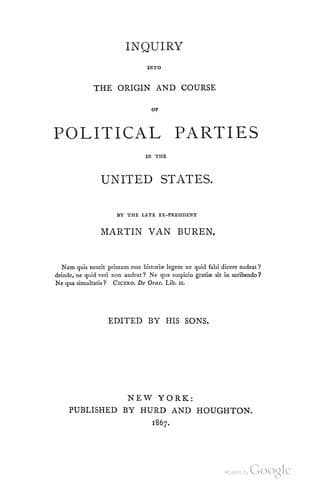
Inquiry Into the Origin and Course of Political Parties in the United StatesVan Buren, Martin
History
Inquiry Into the Origin and Course of Political Parties in the United States
Van Buren, Martin
Political parties -- United States
declined, as did also our creditors in Antwerp, to accept our proposal
for converting the debts due upon loans of that character into a funded
domestic stock.
The whole of our foreign debt in Holland, that which was due at the time
of the passage of the act establishing the funding system as well as
that which was subsequently contracted there and at Antwerp, and the
principal part of that held elsewhere, was paid to the entire
satisfaction of the creditors by the means I have described, and
without being funded. The domestic debt, the least difficult or delicate
to deal with, would doubtless have been seasonably and satisfactorily
discharged in the same way, if General Hamilton had not, at an early
age, imbibed an opinion, which he never changed, that a permanent
national debt was an advantage to any country, and likely to be
particularly useful in a confederacy like ours. That such was his
sincere opinion there cannot be the slightest doubt, and that he
contemplated a public debt here of a character as permanent as that was
likely to be which then existed in England is fairly to be inferred from
his acts.
Hamilton's mind was from a very early period turned to politics, and of
political subjects that of finance was from the beginning the favorite
theme of his meditations, among the most prominent results of which was
a conviction that of the agencies necessary to good government, whatever
might be its form, there were none more useful than a well funded public
debt and a judiciously constructed national bank. At the early age of
twenty-three, whilst filling a post of subordinate rank in the army, he
addressed an anonymous communication (as I have before mentioned) to
Robert Morris, whose mind was inclined in the same direction, and who
was extensively employed in the management of fiscal affairs, enforcing
with much ability his favorite ideas. Some of the contents of this
communication are given in the "Life of Hamilton" by his son. In a
subsequent letter to the same gentleman, he argues in support of kindred
positions. In his report upon public credit he advances the same
favorable opinion, and in substantially the same language, of the
effects of the particular debt he proposed to fund upon terms which
promised perpetuity. He did, it is true, accompany the latter
declaration with a protest against the latitude, inviting to
prodigality, which was sometimes given to the idea of the utility of a
public debt, and with a recommendation in favor of the establishment of
a sinking fund, and other reservations and qualifications, couched in
the guarded terms usually employed by able men in state papers upon
controverted public questions. But the report contained nothing
inconsistent with the idea of keeping on foot a national debt as long as
it did not become "too large,"--a condition that could scarcely fail to
give way to the supposed exigencies of the moment,--and the farther
condition of an indispensable necessity for its continuance never found
Public-domain text, read in full here on John Shaqi.
Reviews
Reviews
No reviews yet
Be the first to share your thoughts on this work.
Elsewhere in the archive
Join the Discussion
Join the discussion
Sign in to leave a comment or review.
Sign InorCreate an account