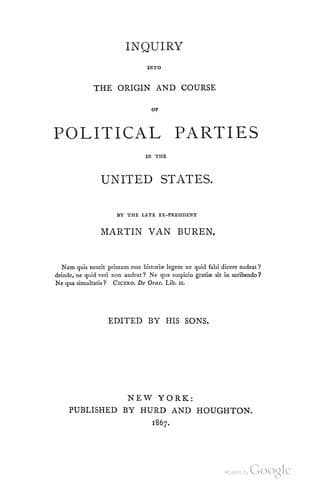
Inquiry Into the Origin and Course of Political Parties in the United StatesVan Buren, Martin
History
Inquiry Into the Origin and Course of Political Parties in the United States
Van Buren, Martin
Political parties -- United States
Alas! how deeply is it to be lamented that this great statesman, as able
as an impracticable man can be, when he knew that he was about to
attempt a ladder upon the first round of which his boldest friend dared
not even to place his foot, had not rather followed, in some respects at
least, the example of his coadjutor and friend, James Madison. The
coincidences in the occurrence of opportunities to make themselves
useful to their country, and the contrasts in the ways in which these
were improved and the consequences that followed, to be found in the
public lives of these illustrious men, are both striking and
instructive. In regard to one subject a partial reference to them has
already been made. They were co-workers in a series of efforts to obtain
from the Congress of the Confederation authority for the Federal head to
levy and collect impost duties to enable it to perform the offices
devolved upon the General Government by the Articles of Confederation,
instead of trusting to the unsafe and unstable requisitions upon the
States. No sooner had the first Congress of the new Government,
established for that and other purposes, formed a quorum, than Mr.
Madison, as we have already seen, before the executive branch had been
organized, or even the President elect been informed of his election,
introduced bills for the imposition and collection of duties on imported
goods, which he pushed forward _de die in diem_ until they became laws,
and the duties were in the process of being collected, and the public
coffers in the way of being replenished. This good work he followed up
in due time by the introduction into Congress of resolutions (and the
most able support of them on its floor) in favor of a commercial policy
recommended by the Secretary of State, Mr. Jefferson, to improve our
trade and thus increase our revenue. These were the contributions of Mr.
Madison, simple, practical, and direct like their author, for promoting
the financial branch of the public service under the new Government,
which was committed by President Washington to the special
superintendence of Alexander Hamilton as Secretary of the Treasury.
The Secretary's contributions to the same objects consisted of two very
elaborate and very able reports, the first upon public credit,
recommending the establishment of a funding system, and the second in
favor of a national bank, embracing plans for each and, in the former, a
scheme to raise funds for the payment of the interest of a debt to be
funded. The _éclat_ which he acquired by these imposing state papers was
so great, and many minds are still so much dazzled by the traditional
splendor of their effects upon the credit and resources of the country
as to render it not a little embarrassing to discuss, in a plain,
matter-of-fact way, the questions of their real influence or
non-influence upon our finances.
Public-domain text, read in full here on John Shaqi.
Reviews
Reviews
No reviews yet
Be the first to share your thoughts on this work.
Elsewhere in the archive
Join the Discussion
Join the discussion
Sign in to leave a comment or review.
Sign InorCreate an account