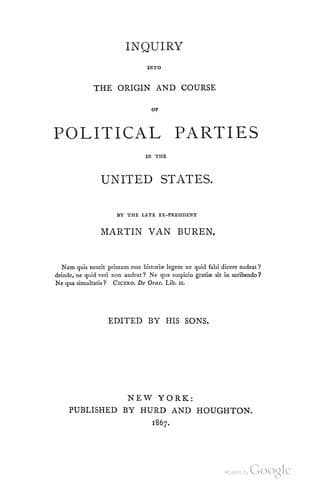
Inquiry Into the Origin and Course of Political Parties in the United StatesVan Buren, Martin
History
Inquiry Into the Origin and Course of Political Parties in the United States
Van Buren, Martin
Political parties -- United States
They both signed the instrument notwithstanding; Hamilton under a sort
of protest against its sufficiency (or rather its want of it), and
Madison with apparent and, I doubt not, real cordiality. In the numbers
of the "Federalist," (of which they were the principal authors,) they
offered a joint and honorable testimonial to the Constitution, which
became in the sequel an enduring monument to their own associated
memories. Each rendered "yeoman's service" in the conventions,
respectively, of New York and Virginia, to decide upon its ratification;
in neither of which was the ratification probable at the beginning, and
in both there is the best reason to believe that, without their powerful
aid, it must have ultimately failed. In such an event the failure of the
Constitution would have been next to certain.
Although Gouverneur Morris's assertion that Hamilton had comparatively
nothing to do with the construction of the Federal Constitution is true,
yet as Madison had a greater agency in that work than any other
individual, and as the obtaining the call of the Convention and the
ratification of the Constitution, in which Madison and Hamilton acted
the chief parts, were also the portions of the whole transaction most
exposed to the action of the States and of the public mind, and
therefore the most difficult of accomplishment, it may with truth be
affirmed that there were not any fifty or a hundred other men taken
together to whom the country was as much indebted for the Federal
Constitution as to those two gentlemen. But in their subsequent
treatment of that sacred instrument, which each had done so much to
bring to maturity, they, unfortunately for the country, differed very
widely. The Constitution was ratified and adopted in the first instance
by more than the requisite number of States, and finally by the whole
thirteen. General Washington was elected President. He appointed
Alexander Hamilton to be Secretary of the Treasury, and James Madison
was elected a member of the first Congress. The latter, although
overruled in the Convention upon points which he deemed important,
acquiesced in the decisions of the majority, accepted the Constitution
in good faith with a determination to do all in his power, not only to
secure its ratification, but to give to the people and the States the
full benefit of its provisions as those were understood by them, and to
do this with the same fidelity and honor with which he would perform any
private arrangement to which he had made himself a party. Satisfied from
numerous exhibitions of public sentiment elsewhere as well as in the
State conventions, and perhaps more particularly in that of his own
State, not only that there was far greater opposition in the minds of
the people at large to the Constitution as it came from the hands of
the Convention than he at first supposed, but that it was, in point of
fact, defective in some particulars important in themselves and well
Public-domain text, read in full here on John Shaqi.
Reviews
Reviews
No reviews yet
Be the first to share your thoughts on this work.
Elsewhere in the archive
Join the Discussion
Join the discussion
Sign in to leave a comment or review.
Sign InorCreate an account