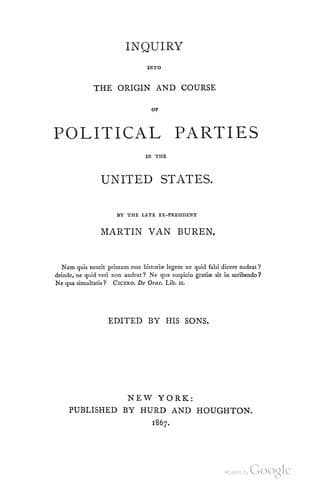
Inquiry Into the Origin and Course of Political Parties in the United StatesVan Buren, Martin
History
Inquiry Into the Origin and Course of Political Parties in the United States
Van Buren, Martin
Political parties -- United States
A tolerably full and obviously fair account of the debates and
proceedings in the House of Representatives upon this subject--those in
the Senate, I fear, are lost--may be found in the first and second
volumes of Lloyd's "Register of the Proceedings and Debates of the
First House of Representatives of the United States," which I am sorry
to find has not been transferred to Colonel Benton's "Abridgment." The
subject, speaking of the ten amendments as one measure, was only second
in intrinsic importance, on account of the influence its success exerted
on the solidity and perpetuity of the new system, to the Constitution
itself, and the debates in point of ability and earnestness,
particularly on the part of Mr. Madison, not inferior to any of the
discussions by which that interesting period when the foundations of the
present government were laid was so greatly distinguished; one cannot
read them without acknowledging the difficulty of recalling another
instance in which a measure of equal gravity was so successfully carried
through a public body against the obvious and decided preferences of a
large majority of its members, or without admiring the extent to which
that success was achieved by the exertions of one man.
Now that the dangers which environed these proceedings have passed away,
they afford amusement to the curious in such matters by the picture they
furnish of the twists and turns to which men in high positions and of
generally fair views will sometimes resort to stave off distasteful
propositions, with the hope of ultimately defeating what they do not
feel it to be safe directly to oppose. The Virginia and New York
applications were presented by Mr. Bland, of the former, and Mr.
Lawrence, of the latter State, both friends of Hamilton; and although
both were solicitous that the applications should be respectfully
received, neither of them ever took a step to make them successful, nor
were they in favor of the amendments proposed by Mr. Madison. That
gentleman gave notice of his intention to bring the subject before the
House several weeks before the day he named for that purpose. When that
day arrived he moved that the House should resolve itself into a
committee of the whole to receive the amendments he proposed to offer.
Opposition to going into such committee came from almost all sides of
the House, some urging one species of objections and some another, but
generally indicative of decided unfriendliness to the views of the
mover. Perceiving that his motion was neither satisfactory nor likely to
succeed, Mr. Madison withdrew it, and submitted a proposition for the
appointment of a select committee to report such amendments to the
Constitution as they should think proper. Having done this, he, in a
very able speech, went over the whole subject, stated at length the
necessity that existed for some amendments, and the high expediency of
proposing others, and furnished a statement of those he had intended to
Public-domain text, read in full here on John Shaqi.
Reviews
Reviews
No reviews yet
Be the first to share your thoughts on this work.
Elsewhere in the archive
Join the Discussion
Join the discussion
Sign in to leave a comment or review.
Sign InorCreate an account