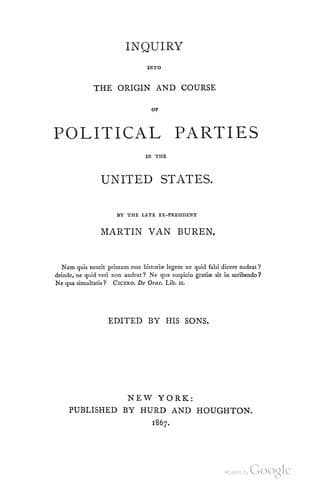
Inquiry Into the Origin and Course of Political Parties in the United StatesVan Buren, Martin
History
Inquiry Into the Origin and Course of Political Parties in the United States
Van Buren, Martin
Political parties -- United States
This substantially, if not exactly, is what Mr. M. said upon that
point. He then went on to conjecture in what way Colonel H.'s
biographer might have been misled into this error; not a doubt being
intimated or evinced by him as to its being honestly an error.
Colonel H. spoke several times in the Convention--at greater or less
length, as would be seen when his (Mr. M.'s) notes were given to the
world. Perhaps, among his papers notes had been found, which, in the
absence of means of discriminating between remarks made on different
occasions, and between notes for an intended speech and that which
the speaker had actually said, might have given rise to the
misconception.
To the foregoing incident you wished me to add what I was led to
say, in the course of the same conversation, regarding Mr.
Jefferson's habitual tone in speaking of Colonel Hamilton. This was
always the very reverse of that in which he spoke of those whose
_characters_, personal or political, were objects of his disesteem.
It was invariably such as to indicate, and to infuse (certainly this
effect was produced upon my mind) a high estimate of Colonel
Hamilton _as a man_, whether considered with reference to personal
matters or to political matters. He was never spoken of otherwise
than as being a gentleman--a lofty-minded, high-toned man. As
regards politics, their convictions, their creeds, were
diametrically opposite. Colonel H. had no faith in republican
government. In his eyes the British Government was the perfection of
human government, the model of all that was practically attainable
in politics. His doctrine, openly avowed, was that there are but two
ways of governing men, but two ways in which the business of
government can be conducted: the one is through fear, the other
through self-interest--that is, influencing the conduct of those
upon whom the course of political affairs depends, through their
desire for personal advantages, for position, for wealth, and so
forth. In this country, to operate upon men through their fears was
out of the question; and consequently the latter constituted the
only practicable means. These political convictions on the part of
Colonel H., united as they were with his splendid abilities _and_
his lofty character as a man, both _public_ and _private_, were
regarded by Mr. Jefferson as having constituted the great peril to
which republicanism had been exposed in our country. But for the
_character_ of Colonel H., for the _man_, for his honesty and
sincerity and single-mindedness,--I mean considered with reference
to politics,--there was never the least indication of depreciation
or disrespect on the part of Mr. Jefferson; always the direct
reverse.
Public-domain text, read in full here on John Shaqi.
Reviews
Reviews
No reviews yet
Be the first to share your thoughts on this work.
Elsewhere in the archive
Join the Discussion
Join the discussion
Sign in to leave a comment or review.
Sign InorCreate an account