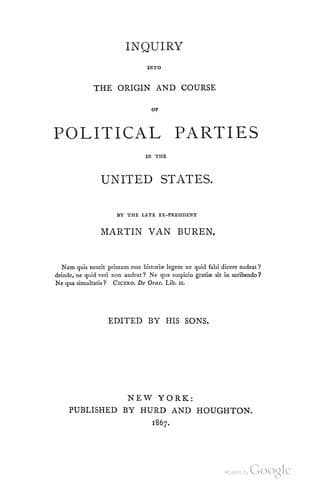
Inquiry Into the Origin and Course of Political Parties in the United StatesVan Buren, Martin
History
Inquiry Into the Origin and Course of Political Parties in the United States
Van Buren, Martin
Political parties -- United States
Hamilton never well understood the distinctive character of our people,
but he understood human nature too well to believe that any people could
long respect or desire to uphold a Constitution the most stringent
provisions of which were thus regarded or treated. Its inevitable fate
is illustrated in the experience of France, after one of her
unscrupulous wits had aided in consigning to general derision that
litter of Constitutions which had rapidly followed one after the other,
by accompanying his oath with a grimace and a jest upon the number which
he had successively and with equal solemnity sworn to support. The
example of France was not lost upon a mind so watchful as Hamilton's,
and he did not doubt that our Constitution would be overthrown with the
same certainty, if not with equal facility, after it had been long
enough treated with similar disrespect, and that the door would be thus
opened for the ultimate introduction, under the influence of the money
power, of the only political institutions in which he placed absolute
confidence. He declared it to be his opinion, in the Convention, that he
regarded ours as the last chance for a republican government, and
assigned that opinion as a reason for his attempt to infuse into the new
system qualities as stringent as those he proposed and which he knew
very well were not generally regarded as belonging to a republican
system. No man better understood than he that the inviolate sanctity of
a written Constitution was the life of a republican government, and that
its days were numbered from the moment its people and rulers ceased thus
to preserve, protect, and defend it. Mr. Jefferson spoke, in his letter,
of Hamilton as "_professing_" that it was "the duty of its
administrators to conduct the Government on the principles their
constituents had elected." I did not at first, and for a long time
afterwards, attach as much significance to the word I have here
italicized, as I do now, when I have studied Hamilton's course more
carefully. I knew the letter was written in a liberal spirit toward his
memory. As I have elsewhere said, during my visit to Mr. Jefferson we
talked most of Hamilton, and the general course of Mr. J.'s remarks was
substantially similar to those now related, more than thirty years after
his decease, and without the slightest knowledge of what I have said
upon the same subject, by his relative, Mr. Trist, who was also a member
of his family. Mr. Jefferson was evidently disposed to confirm the
favorable impressions I had imbibed of the personal side of Hamilton's
character, and the words quoted above from his letter were designed to
qualify his imputation of monarchical principles to the latter, and I
can now appreciate the motive for the expression used, which did not
commit him to a concession that the opinion of Hamilton in regard to the
duty of administration was that upon which he acted.
Public-domain text, read in full here on John Shaqi.
Reviews
Reviews
No reviews yet
Be the first to share your thoughts on this work.
Elsewhere in the archive
Join the Discussion
Join the discussion
Sign in to leave a comment or review.
Sign InorCreate an account