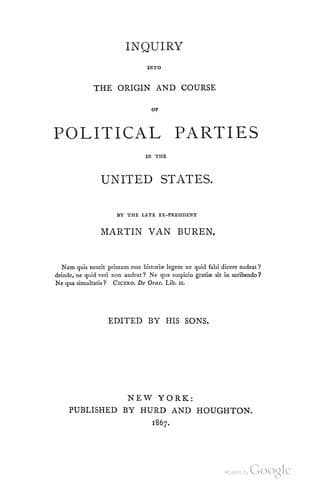
Inquiry Into the Origin and Course of Political Parties in the United StatesVan Buren, Martin
History
Inquiry Into the Origin and Course of Political Parties in the United States
Van Buren, Martin
Political parties -- United States
In these views of General Hamilton's course and in the opinions
expressed in respect to it, I have designed to confine myself strictly
to what I consider the deliberate judgment of the country, pronounced in
various ways and among others through the ballot-box--its constitutional
exponent. The most prominent of his measures have been, as already said,
discarded, and those who constituted the party in whose name they were
first introduced have so far yielded to the current of public opinion as
to abandon them forever. I have also before alluded to the gratifying
circumstance that the odium attached to those measures never in any
degree affected the confidence of the people in the patriotism of
Washington or in his fidelity to republican institutions, or weakened
their affection for him while he lived, or their respect for his memory
when he was no more. These were not the results of mere personal
devotion, but of an intelligent and just discrimination on the part of
the people. Hamilton designed to effect a civil revolution by changing
the powers of Congress from the restricted character given to them in
obedience to the wishes of the people to one in effect unlimited.
Washington entertained no such views. His constructions of the
Constitution were designed for the cases that called them forth, and had
no ulterior views.
The subject of the bank presented the principal and almost the only
question upon which President Washington gave a construction to that
instrument which met the disapprobation and excited the apprehensions of
the old Republicans. To the assumption of the State debts Hamilton, as
has been seen, succeeded in obtaining--how much to his mortification and
regret his writings show--the coöperation of Mr. Jefferson, and thereby
the unanimous support of the cabinet; and his Report on Manufactures, as
to most of its obnoxious details, was not acted upon during Washington's
administration, but in respect to its principal objects remained a dead
letter. President Washington, notwithstanding the conflicting opinions
of his cabinet, gave no reasons for his approval of the Bank Bill. The
public were therefore left to draw their own inferences in regard to
their character. Diverse opinions upon the point of course arose, and
there is much reason to believe (and that belief is strengthened by his
subsequent course in respect to another important matter) that he was
induced to regard a bank as indispensable, in the then condition of the
country, to the success of the new Government--an exigency in public
affairs of that peculiar sort which men in power assume to deal with
under the sanction of the great principle, _Salus populi suprema lex._
(See note.) Mr. Madison, who had demonstrated in Congress its
unconstitutionality at its creation, who had opposed the banking system
through his whole public life, and whose fame was in a very great degree
founded on the ability with which he had defined the true principles of
Public-domain text, read in full here on John Shaqi.
Reviews
Reviews
No reviews yet
Be the first to share your thoughts on this work.
Elsewhere in the archive
Join the Discussion
Join the discussion
Sign in to leave a comment or review.
Sign InorCreate an account