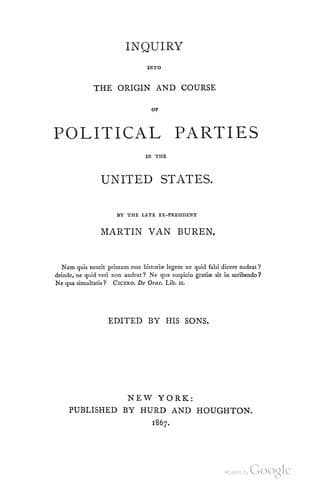
Inquiry Into the Origin and Course of Political Parties in the United StatesVan Buren, Martin
History
Inquiry Into the Origin and Course of Political Parties in the United States
Van Buren, Martin
Political parties -- United States
But we have, fortunately, evidence the most authentic and unequivocal
that President Washington never intended by his approval of the Bank
Bill to express an approval of the systematic and general disregard of
the intentions of the framers of the Constitution, in respect to the
powers of Congress, whenever such disregard should be deemed expedient.
The provisions of the first Apportionment Bill sent to him for his
approval were contrary to the Constitution, and Mr. Jefferson gave an
opinion to that effect and recommending a veto, whilst the opinion of
General Hamilton was in favor of their constitutionality. The division
by which the bill passed had been exclusively sectional, and the
objection of unconstitutionality was raised by the South. The Union was,
at that early period, believed to stand upon a precarious footing, and
the President was seriously apprehensive that the worst consequences
might result, in the then state of the public mind, if he were to throw
himself on the side of his own section by a veto.
His embarrassment and concern were great, and he was sincerely desirous
to avoid a resort to what was then regarded as an extreme measure. He
agreed that the method prescribed by the bill "was contrary to the
common understanding of that instrument (the Constitution), and to what
was understood at the time by the makers of it," but thought "it would
bear the construction assumed by the bill." This was the precise issue
that was raised upon the passage of the bill to establish the bank,
viz.: whether the actual intention, or that which was only inferential,
was to prevail. That he would have withheld the veto if he had felt
himself at liberty in such a case to follow the letter of the
Constitution, and thereby defeat the intention of those who made it, no
one, who examines the matter, will for a moment doubt. He appears to
have been duly sensible of the magnitude of the question in all its
bearings. On the one hand were the evils to be apprehended from a
decision in favor of the South upon a disturbing question by a Southern
President, in a form not only without precedent here, but very
unpalatable--that of a veto; on the other was the grave objection to his
committing himself in favor of the principle which had prevailed on the
question of the bank in a case that did not furnish any thing like an
equal excuse for departing from the honest and straightforward rule of
interpreting the Constitution, like any other instrument, by the
intention of those who made it. He did not fail to see that to act
again, and under existing circumstances, upon the principle to which he
had given his sanction in the case of the bank, would be to commit
himself to Hamilton's latitudinarian doctrines in respect to the
construction of the Constitution, and he vetoed the bill.[29]
[29] Jefferson's _Correspondence_, Vol. IV. p. 466.
Public-domain text, read in full here on John Shaqi.
Reviews
Reviews
No reviews yet
Be the first to share your thoughts on this work.
Elsewhere in the archive
Join the Discussion
Join the discussion
Sign in to leave a comment or review.
Sign InorCreate an account