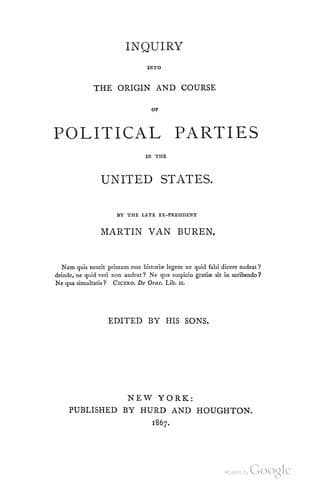
Inquiry Into the Origin and Course of Political Parties in the United StatesVan Buren, Martin
History
Inquiry Into the Origin and Course of Political Parties in the United States
Van Buren, Martin
Political parties -- United States
Anti-republican as these views undoubtedly were, they nevertheless
pointed to principles and to a policy well calculated to make deep
impressions upon large portions of the community, in which were, and
will always be, found many liable to be influenced by such
considerations, and ready to follow the political party organized upon
them; many, if not born in the belief, certainly educated in it, that
they have something to fear from the major part of their
fellow-creatures, and seeing few more important objects for the
establishment of governments among men than to keep these in order and
to protect the well-disposed portions of society like themselves from
the vices and follies of the masses. In the performance of such duties
they very naturally conclude that government should look to the more
intelligent and better informed classes for support, and as naturally
that to enable them to render such support they should receive partial
favors and extraordinary advantages from its administration. Men of this
class, their associates and dependents, as was foreseen, embraced with
alacrity and supported with the energy inspired by self-interest the
principle of political reciprocity between government and its supporters
inaugurated in England at the Revolution of 1688, and ingrafted upon our
system by Hamilton in 1790. He found in the old Federal party a soil
well adapted to the cultivation of that policy, and in conjunction with
those who expected to share in the profits exerted all the faculties of
his great mind to extend the field for its operation.
That extension soon became so great under the fostering influence of
Government and the money power as to include among its supporters,
either as principals or sympathizers, almost every business class in the
community, saving always the landed interest, properly so called, the
mechanics not manufacturers, and the working classes. When I speak of
the landed interest, I allude (as I have before explained) to those only
who cultivate the soil themselves directly or by the aid of
_employées_--to the farmers and planters of the country--and do not of
course include speculators in lands, who buy to sell and sell to buy,
and who, of all classes, are most dependent upon the friendship and most
subject to the influence of the money power.
Public-domain text, read in full here on John Shaqi.
Reviews
Reviews
No reviews yet
Be the first to share your thoughts on this work.
Elsewhere in the archive
Join the Discussion
Join the discussion
Sign in to leave a comment or review.
Sign InorCreate an account