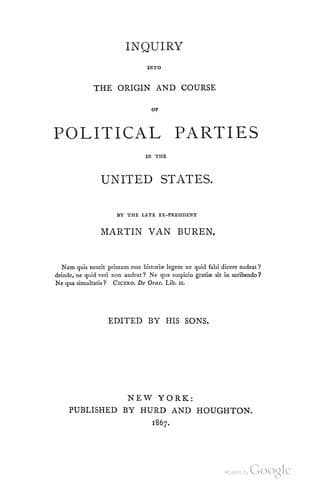
Inquiry Into the Origin and Course of Political Parties in the United StatesVan Buren, Martin
History
Inquiry Into the Origin and Course of Political Parties in the United States
Van Buren, Martin
Political parties -- United States
railroads, of bridges, of canals, where they can be made profitable, and
other constructions to which the invention and industry of man can be
successfully applied. Individuals frequently go into these powerful
associations with opposite political feelings, but are ultimately almost
invariably induced to change them altogether, or to modify them so much
as to satisfy their partners that their democratic principles are not
sufficiently stringent to be troublesome. The possession of special and,
in some of these cases, of exclusive privileges, is certain sooner or
later to produce distrust of the less favored body of the people, and
distrust grows apace to the proportions of prejudice and dislike. There
are of course striking exceptions to this rule, as to every other.
There are always men connected with these associations whose democratic
principles are so deeply implanted in their very natures as to place
them above the influence of circumstances; but they are few and far
between. These changes are not the fruit of infirm purposes or
characters, but are produced by influences which seem no farther
traceable than is here imperfectly done, and are yet sufficiently
effective to convert to Hamiltonian principles more than three fourths
of the Democrats who become members of the associations of which I have
spoken.
Such aggregations of wealth and influence, connected as they usually are
or soon become with social distinctions, naturally come to be regarded
as the fountains of patronage by those who are in search of it. The
press, men of letters, artists, and professional men of every
denomination, and those engaged in subordinate pursuits who live upon
the luxurious indulgences of the rich, are all brought within the scope
of this influence. It is perhaps in this way only that we can account
for the remarkable disparity in number between the newspapers and other
periodicals advocating Democratic principles and those which support the
views of the money power and its adherents--a disparity the
extraordinary extent of which will strike any one who visits a common
reading-room, in which, amid the well-furnished shelves and full files
of the publications of the latter class, it is rare that we find many of
the former, often not more than a single newspaper, sometimes not one.
Yet those which we do not find there represent the political principles
of a large majority of the people. The same fact attracts the attention
of the observer in passing through countries abroad which are under
monarchical institutions.
Public-domain text, read in full here on John Shaqi.
Reviews
Reviews
No reviews yet
Be the first to share your thoughts on this work.
Elsewhere in the archive
Join the Discussion
Join the discussion
Sign in to leave a comment or review.
Sign InorCreate an account