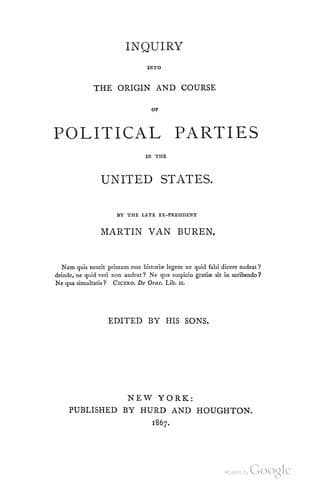
Inquiry Into the Origin and Course of Political Parties in the United StatesVan Buren, Martin
History
Inquiry Into the Origin and Course of Political Parties in the United States
Van Buren, Martin
Political parties -- United States
John Quincy Adams was the first President, after the civil revolution of
1800, who entered upon the duties of his office with views of the
Constitution as latitudinarian as were those of Hamilton, and the only
one of that stamp who possessed sufficient force of character to make
his will the rule of action for his cabinet, and who lived long enough
to make it to some extent effectual. Although elected as a convert to
the principles of the then Republican party, he was no sooner seated in
the Presidential chair than he disavowed those principles in their most
important features--those of Constitutional construction--and marked out
a course in that regard which he intended to pursue. He thereby united
that party against his reëlection to an extent sufficient to defeat it
by an overwhelming majority.
Of the party which thus a second time vindicated the Constitution, by
far the most effective ingredient was the landed interest. But though
the most powerful, it was yet far from being its only valuable element,
for, to use Mr. Jefferson's words on the former occasion, there was
besides "a great mass of talent on the Republican side."
If there be any whom experience has not yet satisfied of the power of
the landed interest, and of its capacity to cope successfully with the
money power of the country, enormous as has been the growth of the
latter, let them consider the facts disclosed by the census. By that of
1850, our population, as affecting the point under consideration, is
shown to have consisted at that time of _farmers_, two millions three
hundred and sixty thousand; of planters, twenty-seven thousand; of
laborers engaged in agriculture, thirty-seven thousand; of persons
engaged in commerce, trade, manufactures, mechanic arts, and mining, one
million six hundred thousand; in law, medicine, and divinity,
ninety-four thousand. Let them compare these with previous enumerations,
and they will see how invariable and large is the disproportion in
numbers between the agricultural and other classes. That disproportion
must of course have been greater during our colonial existence and at
the Revolutionary period, when our commerce was trifling, and we were
almost if not entirely destitute of manufactures. We are hence able to
form an idea of the extent to which the defense of the principles which
the colonists cherished, and for the maintenance of which the Revolution
was made, rested on the broad shoulders of the landed interest from the
beginning to the end of that great contest.
Public-domain text, read in full here on John Shaqi.
Reviews
Reviews
No reviews yet
Be the first to share your thoughts on this work.
Elsewhere in the archive
Join the Discussion
Join the discussion
Sign in to leave a comment or review.
Sign InorCreate an account