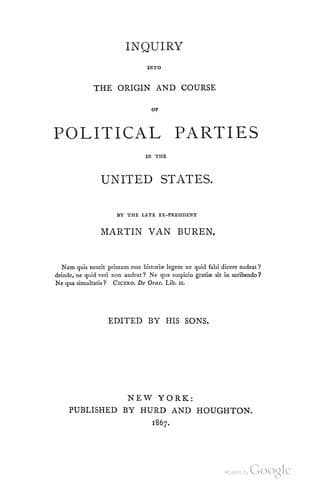
Inquiry Into the Origin and Course of Political Parties in the United StatesVan Buren, Martin
History
Inquiry Into the Origin and Course of Political Parties in the United States
Van Buren, Martin
Political parties -- United States
ratified by several of the States, and amongst them by Virginia and New
York, with accompanying resolutions, some of them passed by the State
conventions with perfect unanimity, expressing opinions that it deserved
revision and required amendments. Without such resolutions the
ratification could not, we are forced to believe, have been effected. We
have seen with what reluctance the first Congress, Federal by a large
majority, consented to make any constitutional amendments, and that
nothing short of Mr. Madison's wonderful perseverance could, in all
probability, have effected their adoption; but they were obtained,
proved satisfactory to the Anti-Federalists, and made them fast friends
of the new Constitution.
[31] See _Life of Morris_, Vol. III. p. 128. "But the thing which in
my opinion has done more mischief to the Federal party is the ground
given by some of them to believe that they wish to establish a
monarchy."--_Letter from Morris to King._
From that moment that instrument ceased to be an object of solicitude
with the leaders of the Federal party, hardly retaining favor with any
of them. This result is by no means an unusual one in the history of
parties whose feelings have become to any great extent embittered. The
instances are rare indeed in which any public measure or act is at the
same time entirely acceptable to all sides. The "Independent Treasury"
is the only clear case of the kind among us that has fallen under my
observation. The letters of the leading Federalists, which have now for
the first time seen the light, prove their subsequent indifference, and,
in many instances, active hostility to the Constitution. Not a few who
imbibed Hamilton's feelings and shared in his views upon this point had
been members of the Convention, and among those to whom I have awarded
so large a share of credit for their conduct in making the Constitution
what it is. This was justly their due. It is not to be doubted that
several of them, as I have before said, participated largely in
Hamilton's objections, and would have preferred a very different
instrument; but they knew that none less favorable to the supposed
interests of the State governments, or less liberal in other respects,
would stand the slightest chance of ratification, more especially when
the circumstance of disregard to the limits and restrictions of the
authority by which they had been convened was taken into consideration.
They saw nothing but injury, vast and complicated, to the country from
their failure, and they evinced their patriotism in yielding to this
wise foresight at the sacrifice of their individual preferences.
Although many of them, doubtless, did not fully share Hamilton's
absorbing preference for monarchy, they very generally went to the
extent pointed out by John Quincy Adams in his Jubilee Address--that was
for a government of more energy than was provided for by the
Constitution presented by the Convention. This they had a right to
Public-domain text, read in full here on John Shaqi.
Reviews
Reviews
No reviews yet
Be the first to share your thoughts on this work.
Elsewhere in the archive
Join the Discussion
Join the discussion
Sign in to leave a comment or review.
Sign InorCreate an account