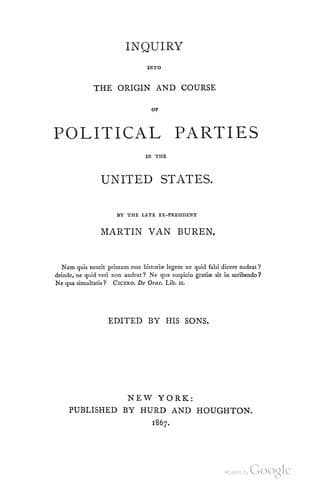
Inquiry Into the Origin and Course of Political Parties in the United StatesVan Buren, Martin
History
Inquiry Into the Origin and Course of Political Parties in the United States
Van Buren, Martin
Political parties -- United States
It has from the beginning been the constant aim of the leading
Federalists to select some department, or some nook or corner in our
political system, and to make it the depository of power which public
sentiment could not reach nor the people control. The judicial was not
the department which Hamilton deemed the best adapted to that end, and
his opinion upon such points seldom failed to become that of his party.
He liked the judiciary as well on account of its being the only branch
of the Government that was constituted, in regard to the tenure of
office, upon the principles he preferred, and which he had proposed in
the Convention for other offices also, as on account of its usefulness
in protecting the rights of persons and property against vicious
legislation or lawless violence. But regarding the exercise of its
powers in no other light than through its judgments in cases "in law and
equity" that were brought before it by parties litigant, the only sense
in which they were regarded by the framers of the Constitution, he
thought it too weak a department for his purpose. This was nominally to
influence, but really to control, the action of the public mind--an
object which, he never hesitated to declare, could only be effected by
appeals to the interests or the fears of the people, and the judicial
power did not possess the means to make either effectual. This opinion
of the weakness of the judicial power he frequently avowed, and
particularly in the 78th No. of the "Federalist." The judiciary, he
there said, "was incontestibly the weakest of the three departments of
power;"--that "though individual oppression might now and then proceed
from the courts of justice, the general liberty of the people could
never be endangered from that quarter;"--that it had "no influence over
either the sword or the purse; no direction either of the strength or of
the wealth of the society; and can take no active resolution whatever.
It may truly be said to have neither _force_ nor _will_, but merely
judgment; and must ultimately depend upon the aid of the executive arm
for the efficacious exercise even of this faculty." In support of these
views he cited Montesquieu, who, speaking of them says: "_Of the three
powers above mentioned, the Judiciary is next to nothing._" Thus
regarding the judicial department, Hamilton selected the executive and
legislative as those best adapted to his purposes. Of the means which
those departments possessed he spoke in the same number of the
"Federalist" in the following strain: "The executive not only dispenses
the honors, but holds the sword of the community; the legislative not
only commands the purse, but prescribes the rules by which the duties
and rights of every citizen are to be regulated." These were the
departments, through the instrumentality of which, invigorated as he
designed to invigorate them by his construction of the Constitution, he
hoped to make ours a practicable government. Sustained by a Congress, a
Public-domain text, read in full here on John Shaqi.
Reviews
Reviews
No reviews yet
Be the first to share your thoughts on this work.
Elsewhere in the archive
Join the Discussion
Join the discussion
Sign in to leave a comment or review.
Sign InorCreate an account